Heilongjiang calling for exclusion zone and incentives to avoid "possible contamination"
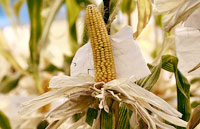
National legislators from Heilongjiang province, which is China's principal producer of non-genetically-modified soybeans, are calling for a law to set up a special zone where the planting and processing of GM plants is prohibited.
Deputies to the country's top legislature hope such a law would preserve ecological diversity, benefit farmers who plant non-GM soybeans and avoid "possible contamination" of the soybean crop by GM plants.
The size of the proposed special zone would restore the province's soybean growing acreage to its 2010 level of about 4.3 million hectares, said national lawmaker Tan Zhijuan.
Tan said schools and universities in Heilongjiang and beyond should have first call on the non-GM soybean products coming out of the special zone.
"Heilongjiang, China's largest producer of non-GM soybeans, has seen its planting acreage downsize to a tipping point of 1.4 million hectares," said Tan, who is a veteran agricultural specialist. "This represents a drop of a staggering 66 percent in five years following the influx of much cheaper GM imports."
The per-ton CIF (cost, insurance and freight) price of foreign GM soybeans tends to be around 500 yuan ($77) to 1,000 yuan cheaper than domestic soybeans, according to Tan.
Using her hometown, Nehe, as an example, Tan said the city reserved 60 percent of its 333,000-hectares of arable land for soybeans back in the 1980s. That 220,000-hectare area has now shrunk to 66,000 hectares, or around one-fifth of the former area.
Nationwide, China imported 81.7 million tons of soybeans — mostly GM ones — last year, which meant more than 80 percent of its soybean consumption was met by imports, said Tan and five other deputies in their proposal submitted to the National People's Congress.
Many botanists believe the soybean plant to have derived from a legume native to China.
"China has the world's most diversified wild soybean resources. As a responsible country, it must protect germplasm resources (living genetic material including seeds and tissue used for plant breeding, preservation and research) of the crop," Tan said.
With the except of cotton and papaya, China has prohibited GM farm produce, including staple foods, from being grown commercially in the country, according to Chen Xiwen, director of the office of the central agricultural work leading team.
Although the planting of GM soybeans has not been detected so far in Heilongjiang, there are risks that GM seeds might find their way to the fields, for example, through leakage from road transportation, Tan warned.
She said the key to establishing the non-GM soybean protection zone would be to build up an industrial chain that streamlines the planting, processing and sales of non-GM soybeans.
This non-GM industrial chain will differentiate itself from that for GM products and improve the competitive edge of the domestic soybean industry to target its niche market, Tan said.
Supporters would like to see a provincial soybean planting association and a processing industrial association in the zone to coordinate and advise on soybean procurement and oversee the growing acreage.
Sun Bing, another legislator from Heilongjiang, said that if the province retreated from or gave up on growing non-GM soybeans, the foreign monopoly of China's soybean market would intensify and more soybean enterprises would fail.
Sun proposed developing a soybean futures market to help farmers buffer the price fluctuations in the global market.
Liu Zhongtang, a retired specialist with the Heilongjiang Academy of Agricultural Sciences who has studied soybeans for 55 years, said that while the safety of GM food is a controversial issue, there is no question that green, non-GM food is good for people's health.
"Even without a protection zone, we still need to install a stringent management mechanism to put an end to production and processing of any GM soybeans (in Heilongjiang)," Liu said. "Heilongjiang soybeans themselves are a brand that has advantages in quality and price in the domestic market and for export and it will win an increasing endorsement from consumers."
Copyright 1995 - . All rights reserved. The content (including but not limited to text, photo, multimedia information, etc) published in this site belongs to China Daily Information Co (CDIC). Without written authorization from CDIC, such content shall not be republished or used in any form. Note: Browsers with 1024*768 or higher resolution are suggested for this site.
License for publishing multimedia online 0108263 Registration Number: 20100000002731