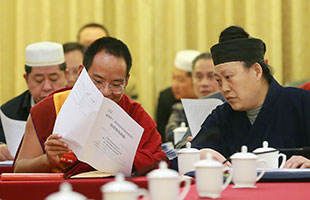
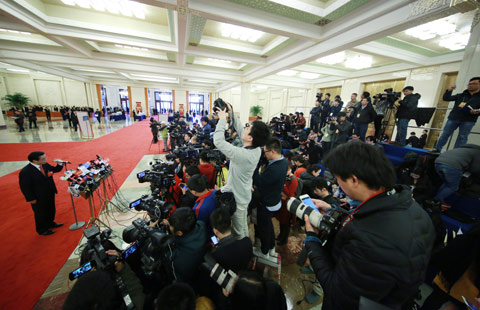
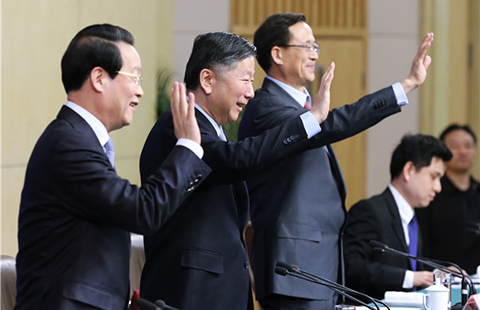
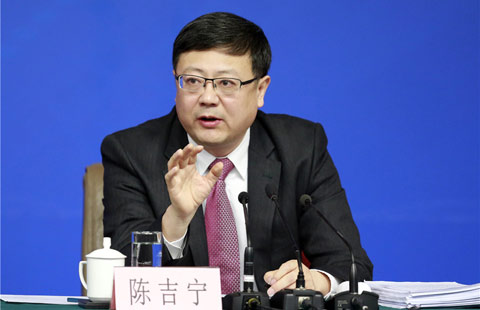
As national legislators wrap up their annual gathering on Wednesday, I'm assessing the trail they will have left behind in Beijing during their 12-day stay.
Not their footprints, of course. Flipping through the hundreds of pages of proposals, complaints and criticism, I'm amazed at the tremendous scope of the workload that government departments and organizations now face.
Why?
First, the country's Constitution invests a national legislator with the power to place any proposal or idea before the National People's Congress, the country's top legislature, and its standing committee. According to the law, the appropriate government departments and organizations must process and reply to all of them.
Second, legislators' proposals number in the thousands, and they cover all aspects of Chinese life.
Last year, NPC deputies offered a staggering 8,239 proposals, according to He Yehui, deputy secretary-general of the NPC's standing committee. In 2014, the figure was even higher, at 8,576 proposals.
In both years, about 80 percent of the issues raised by the 2,900 or so lawmakers were resolved, or are in the process of being settled, He said.
I talked to dozens of deputies from Southwest China's Guizhou and Sichuan provinces and some from East China's Shandong province, and realized they had usually conducted investigations, organized meetings and even used questionnaires to understand their constituents' needs before heading to Beijing.
Sometimes a legislator's proposal may seem trivial to an outsider, but the issue matters a lot to the people who see the lawmaker as their spokesperson.
Take Sun Jianbo, for instance. The legislator from Shandong is urging lowered thresholds and improved conditions that would allow the disabled to participate in the province's annual marathon on an equal footing.
Then there's Yang Jie, a deputy from Anhui province. Alarmed by the increase in traffic fatalities in rural areas, Yang has proposed revising the country's driver's license examination rules.
"It should be made compulsory for drivers to pass tests on tricky and bumpy rural roads," Yang said.
Jing Xinhai, another deputy from Shandong, called for a national DNA database to help track missing children, offering a solution to what he lamented was the country's low rate of success in recovering lost children.
Zong Qinghou, a national legislator from the affluent coastal province of Zhejiang, wants to lend a hand to young people who are grappling with housing woes.
"As young men are the key force in realizing the Chinese Dream, the government should guarantee every young family an affordable house, thus addressing one of their fundamental needs," Zong said in his proposal.
And then there's Pan Runlan, from Central China's Hunan province, who said he speaks for the dead and those they leave behind.
"A 24-month salary compensation is offered to the family of deceased public servants and retirees in cities, but not for rural residents," Pan said. "They are all Chinese citizens and must be treated equally."
One of the most stubborn lawmakers in the group may be Wang Mengshu of the NPC's Henan delegation. The academician from the Chinese Academy of Engineering has persistently pursued the creation of compulsory standards for tire pressure monitoring systems.
"I first put up the proposal seven years ago, and this is the eighth time I've done this," Wang said.
"I wonder how much more time it will take for the automobile industry authorities to pay attention to my proposal and implement compulsory standards, which are important to the property and safety of the people."
Copyright 1995 - . All rights reserved. The content (including but not limited to text, photo, multimedia information, etc) published in this site belongs to China Daily Information Co (CDIC). Without written authorization from CDIC, such content shall not be republished or used in any form. Note: Browsers with 1024*768 or higher resolution are suggested for this site.
License for publishing multimedia online 0108263 Registration Number: 20100000002731