Editor's note: At this year's two sessions-the biggest political event of the year, the deliberation of China's 13th Five-Year Plan (2016-20), which maps out the country's development path for the next five years, will be the major point of discussion. The draft plan stipulates that China will continue the reform and opening-up policy that began in the late 1970s. In the first of our in-depth reports during the two sessions, China Daily examines one of the most important academic exchanges of the 1980s, which marked the reform and opening-up program and helped the world gain greater and deeper understanding of China's growing role on the global stage.
 |
|
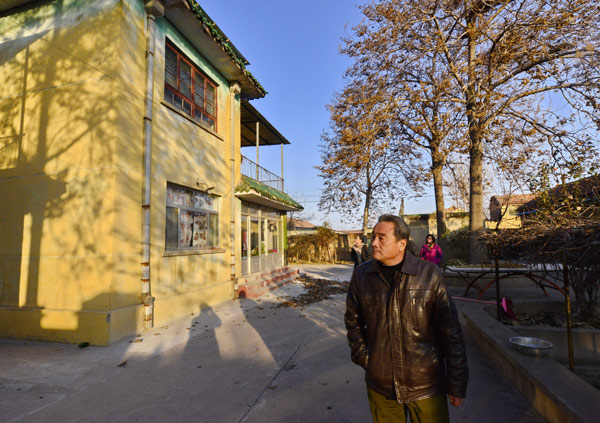
Feng Yuezhao, head of Fengjiacun village, stands in front of the 16-room buildings that were built in 1987 to provide homes for academics from the United States in Zouping county, Shandong province.[Photo by Ju Chuanjiang/China Daily] |
For many years, Shi Changxiang, a chain-smoking county official from Shandong province in East China, was unaware that his tobacco addiction was regarded as a potential threat to the future of a hard-won research project between China and the United States.
The concerns were raised by Michel Oksenberg, an academic who was also a senior member of the US National Security Council. Oksenberg was closely involved in the normalization of US-China relations during the administration of president Jimmy Carter.
One of his initiatives was a cherished research project that allowed 87 US academics to visit Zouping county in Shandong between 1987 and 1991; sometimes the academics stayed for months to research issues ranging from local finance to the status of women, history to animal husbandry.
The smoking story was related by Guy Alitto, professor of history at the University of Chicago and an active participant in the project. "It can be traced back to 1979, when the late Chinese leader Deng Xiaoping visited the United States. During that visit, the two sides reached an agreement whereby the US National Academy of Sciences and Chinese institutions could exchange scholars for research programs every year," Alitto said. "Then, in 1984, Oksenberg, on behalf of the Committee for Scholarly Exchange with the People's Republic of China, wrote to Deng requesting that China provide a rural site for academic research."
Eventually, Zouping, with a population of more than 600,000, was chosen, and Shi, director of Zouping's foreign affairs' office, was tasked with overseeing the project. That was when his heavy smoking began to alarm Oksenberg.
"After his visit in the summer of 1987, Oksenberg expressed his concerns that Shi might die from smoking," Alitto recalled. "He was genuinely concerned that his 'highly possible' death might harm the project that had taken so long to hatch."
Alitto's last visit to Zouping occurred in 2012, and the 73-year-old said it felt as though he had traveled back through time to the days when China's streets looked distinctly different from those in the US.
"When I first arrived in Zouping, in 1986, the county town had only two completely paved roads, and there were still piles of hay on the streets of the oldest part of the county town. In fact, its first movie theater had just opened the year before," he said.
Feng Yuezhao, head of Fengjiacun, one of more than 800 small settlements in Zouping, said that in the 1980s, the county was "very typical of rural China. It was neither rich nor poor. Back then, we had both agriculture and industry. Overall, the collective economy dominated," the 61-year-old said.
Steep learning curve
Before the researchers could begin to get to grips with county life, they had to overcome a number of obstacles, including gaining a working knowledge of the local dialect, and a diet that included "delicacies" such as scorpions, silkworm larvae and grasshoppers.
The language barrier was also daunting for Alitto, even though he had studied Chinese and had acted as an interpreter for the first official Chinese delegation to the US in 1972 in the wake of president Richard Nixon's visit to China.
Copyright 1995 - . All rights reserved. The content (including but not limited to text, photo, multimedia information, etc) published in this site belongs to China Daily Information Co (CDIC). Without written authorization from CDIC, such content shall not be republished or used in any form. Note: Browsers with 1024*768 or higher resolution are suggested for this site.
License for publishing multimedia online 0108263 Registration Number: 20100000002731