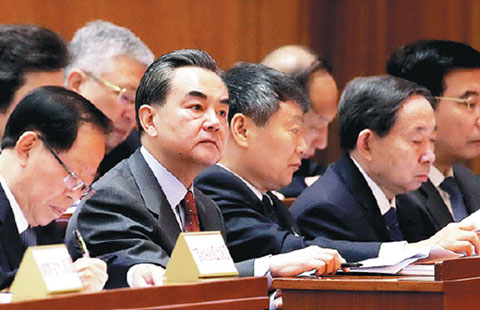
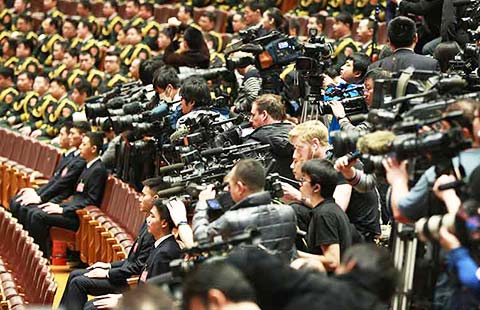
The Presidium of the National People's Congress may introduce a bill to the National People's Congress for due consideration during its current session.
The Standing Committee of the NPC, along with the State Council, the Central Military Commission, the Supreme People's Court, the Supreme People's Procuratorate and special committees of the NPC may introduce a bill to the NPC, which will be put onto the agenda of the current session by the Presidium.
A delegation, or group of no less than 30 deputies, may introduce a bill to the NPC, where on, the Presidium will decide if the bill is to be put onto the agenda or referred to a special committee for further consideration. If the special committee will recommend it for consideration, the Presidium will decide to proceed or not. During its consideration the committee may invite the sponsor of the bill to attend such a meeting.
When the NPC is not in session, a bill for consideration must first be submitted to its Standing Committee which may then refer the bill on to the NPC after it has taken due consideration of the procedures for referral, set out in Section 3 of Chapter 2 of the Legislation Law. Thereafter the Standing Committee, or sponsor, will brief the plenary session on the bill.
A bill which the Standing Committee submits to a forthcoming session of the NPC must be followed by the distribution to the deputies of the draft law one month before the session begins.
Consideration of a bill which has been included on the agenda of a current session of the NPC must begin with a briefing to the plenary meeting by the bill sponsor. During the consideration process the sponsor will have representatives hear comments and answer questions.
Upon the request of an examining delegation, the agent or organization relevant to the deliberation will have representatives to brief the session.
Once a bill has been put on the agenda of a session of the NPC, it shall be deliberated fully by the relevant committee, its findings submitted and then printed and distributed to all deputies attending the session.
A bill which has been put on the agenda of the current session must be reviewed by the Law Committee and a report delivered for consideration to the Presidium along with the amended draft law. The report must contain an explanation of the main differences in opinion on the bill. Once deliberated, the Presidium passes the deliberation report and the amended draft law for due printing and circulation to all attending deputies.
The executive chairman of the Presidium may call for a session of delegation leaders to discuss the range of opinions that a proposed bill, included on the agenda for the current session, covers. The executive chairman will then report the findings of the discussion back to the Presidium.
The executive chairman of the Presidium can also call a session of deputies, elected to discuss major issues related to the bill, and report to the Presidium on the discussion and expressed opinions.
Should the sponsor of a bill wish to withdraw from the agenda of a current session of the NPC, they may do so providing adequate explanation is given by the bill sponsor, and the Presidium agrees, following a report submission, and reading, to the plenary session before the bill is terminated.
In the case of additional considerations and deliberations arising in the course of a bill's progress through the plenary session, the Standing Committee may conduct further deliberations, and reports its decision to the next session of the NPC. The Standing Committee may also conduct further considerations and prepare amendments that may be submitted at the next session.
Once the deputies have deliberated, the draft law will be amended by the Law Committee, based on the opinions of the deputies. The voting version of the draft law will then be submitted by the Presidium to the plenary session for voting on. These bills will be adopted if they achieve successful voting from more than half of the voting deputies.
A national law enacted by the NPC will be promulgated by a signed presidential order from the President of the state.
Copyright 1995 - . All rights reserved. The content (including but not limited to text, photo, multimedia information, etc) published in this site belongs to China Daily Information Co (CDIC). Without written authorization from CDIC, such content shall not be republished or used in any form. Note: Browsers with 1024*768 or higher resolution are suggested for this site.
License for publishing multimedia online 0108263 Registration Number: 20100000002731