Abe's Pearl Harbor visit masks 'hawkish' intent
 |
|
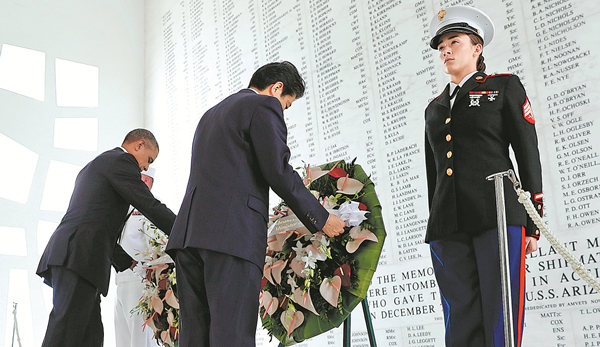
US President Barack Obama and Japanese Prime Minister Shinzo Abe lay wreaths at the USS Arizona Memorial in Hawaii on Tuesday. Carolyn Kaster / AP |
Japanese prime minister only trying to strengthen US alliance to curb rise of China, analysts say
Japanese Prime Minister Shinzo Abe's visit to Pearl Harbor, criticized by China as lacking in sincerity, was quickly followed by one of his Cabinet ministers visiting a Tokyo war shrine on Wednesday.
According to analysts, Abe's visit to Pearl Harbor, the target of the 1941 Japanese surprise attack on Hawaii, had hawkish intentions at heart, not pursuing peace and reconciliation. The purpose, they said, was to broaden Japan's military capabilities and curb the rise of China by strengthening the alliance with the United States.
On Tuesday, Abe and US President Barack Obama laid wreaths at the USS Arizona Memorial.
Afterward, in a speech, Abe said that Japan would never again wage war. On Dec 7, 1941, the Japanese attack on Pearl Harbor killed more than 2,400 US citizens and drew the US into World War II.
Not long after Abe spoke, Masahiro Imamura, the minister in charge of reconstruction of northern Japan after the 2011 tsunami, offered prayers at the Yasukuni Shrine, which honors Japan's war dead, including 14 Class-A war criminals from World War II. Class-A convicts were found guilty of plotting and carrying out the war.
Chinese Foreign Ministry spokeswoman Hua Chunying said Japan should reflect upon its war crimes in a sincere manner rather than "make political shows repeatedly". She spoke at a regular news conference on Wednesday.
The reconciliation between Japan and victimized Asian countries, including China, must be based on Tokyo's sincere reflection on the suffering it caused, she said, adding that some Western media have used words like "shrewd" to describe Abe's visit.
In the Financial Times, writer Joji Sakurai called Abe's visit "a dovish act that masks a hawkish intent". The visit is "shrewd politics", through which Abe could defuse fears about militarism reawakening in Japan, Sakurai wrote.
"Mr. Abe's dream is to revise Japan's pacifist Constitution, drawn up by the US under postwar occupation, to allow the country to have a real army," he wrote.
Related stroties:
China firmly opposes Japanese DM visit to notorious war shrine
China's military voices firm opposition to Japanese DM's war shrine visit