Nation to send unmanned probes to Mars, Jupiter by 2030
 |
|
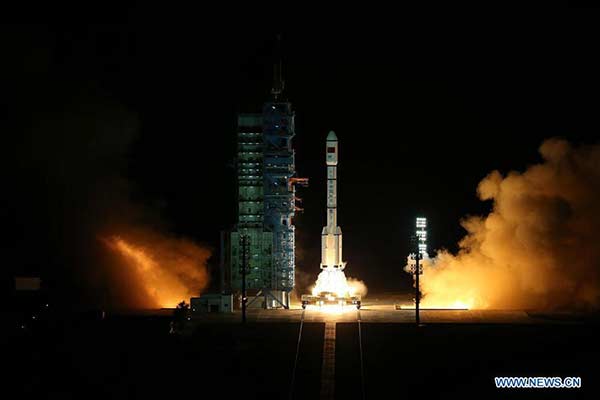
China launches space lab Tiangong-2 into space on Sept 15, 2016, paving the way for a permanent space station the country plans to build around 2022. [Photo/Xinhua] |
China plans to send unmanned probes to explore Mars and Jupiter by 2030, said a senior space official.
Wu Yanhua, deputy director of the China National Space Administration, said at a news conference in Beijing on Tuesday that the government has decided to send a robotic probe to Mars to orbit and land on the red planet around 2020. The probe will conduct scientific research on the Martian soil and atmosphere and search for signs of water.
"The project has proceeded well since it was approved in January. Now we have finalized the overall plan and begun to develop related equipment such as the Mars rover," he said.
A larger probe also will set off for Mars around 2030 to take samples and return to Earth, he said.
The conference was held by the State Council Information Office to issue the China's Space Activities in 2016 white paper, which reviews progress made in 2016 and discloses major tasks for the next five years.
Jupiter as well as its moons will be visited by at least one unmanned probe from China before 2030, Wu said.
Illustrations show the country's first Mars probe consisting of three parts — an orbiter, lander and rover. The rover will have six wheels and four solar panels.
The probe is expected to take nearly seven months before reaching the red planet, said Zhang Rongqiao, chief scientist of China's Mars exploration program.
The rover will carry 13 scientific instruments, weigh about 200 kilograms and work 92 days on the planet, according to Sun Zezhou, chief designer of the probe.
Wu also said Tuesday that the Chang'e 5 lunar probe will be sent to the moon by the end of 2017 to take samples and return to Earth. In 2018, Chang'e 4 will carry out the world's first soft landing — using rockets to slow descent — on the far side of the moon.
China has launched three robotic lunar exploration missions, including one that soft-landed a rover on the moon.
To realize China's grand aspirations, scientists have started to design a super-heavy rocket, the Long March 9, and plan to put it to use around 2030, Wu said.