Home /
China
/ Innovation
Home /
China
/ Innovation
China launches satellite to monitor global carbon emissions



 |
|
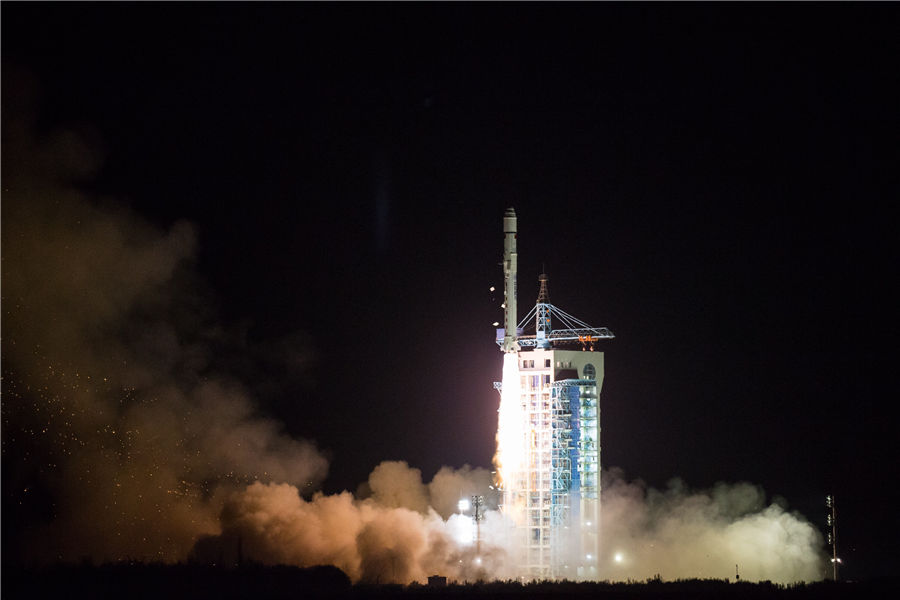
The Long March-2D rocket carrying a carbon dioxide monitoring satellite blasts off from the launch pad at the Jiuquan Satellite Launch Center in Jiuquan, Northwest China's Gansu province, Nov. 22, 2016. This was the 243rd mission of the Long March series rockets. Besides TanSat, the rocket also carried a high-resolution micro-nano satellite and two spectrum micro-nano satellites for agricultural and forestry monitoring. [Photo/Xinhua] |
WORLDWIDE SCOPE
Many countries are reducing emissions, but calculating how much they are actually doing is difficult. Ground-based monitoring cannot collect accurate data on a global scale, so satellites offer the best means of measuring CO2. Japan and the United States have their own monitoring satellites, but two are far from enough to assess the whole world.
"Since only the United States and Japan have carbon-monitoring satellites, it is hard for us to see first-hand data," said Zhang Peng, TanSat application system commander and vice director of the National Satellite Meteorological Center.
"Before, all our data came from ground stations. That kind of data is both local and limited, and does not cover the oceans," Zhang said.
"The satellite has worldwide scope and will improve data collection. Observing atmospheric CO2 by satellite demands cutting-edge technology, so TanSat is a major technological achievement for China," Zhang said.
"We hope TanSat will work with carbon-monitoring satellites of other countries and provide ample data for studying climate change," said Li Jiahong, chief engineer of the National Remote Sensing Center.
Researchers took almost six years to develop TanSat and its high-resolution CO2 detector.
"The TanSat has very good "vision," and can distinguish changes in atmospheric CO2 as small as 1 percent," said Yin. Cloud and aerosol detectors minimize interference, making observations more accurate.
The satellite has different modes for observing oceans and land, and can constantly adjust its orientation and position. To ensure the accuracy of TanSat, six ground-based observation stations will calibrate and examine observational data.
"We can now collect carbon data from all over the world, all year round, and record the carbon contributed by both developed countries and the developing countries," said Lin Chao who was involved in developing the detectors.
"As for China, we can have detailed analysis on emissions in different regions, provinces and cities, thanks to the satellite," said Lin.