4 emerge after 6-month 'Mars trip'
 |
|
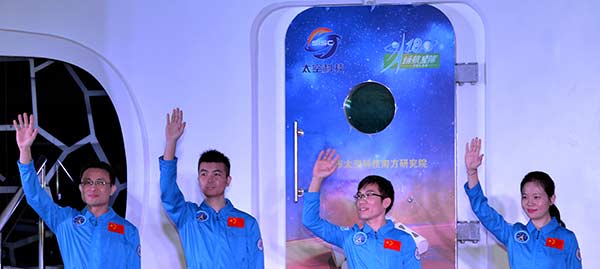
Four volunteers emerge from a mock space capsule on Wednesday in Shenzhen. MAO SIQIAN/XINHUA |
After spending 180 days sealed in a "space capsule" in Shenzhen, Guangdong province, in an experiment to simulate a long journey to Mars, four volunteers finally got to "return" to Earth on Wednesday as the experiment concluded.
The three men and one woman emerged from their 370-square-meter, eight-cabin module at the Space Institute of Southern China to a welcome by officials and scientists working on China's space exploration program.
Two of the volunteers, commander Tang Yongkang and Tong Feizhou, the female volunteer, are researchers at the Astronaut Center of China, while the others, Luo Jie and Wu Shiyun, are members of the public who applied to take part in the experiment, according to the center.
The volunteers were sealed in the module on June 17 and began to live on Mars time throughout the experiment, meaning days within the module lasted 24 hours and 40 minutes. They were sealed off from the Earth's sunlight and had to readjust to the longer days.
Several Chinese and international institutions participated, including the astronaut center, Harvard University and the German Aerospace Center.
Li Yinghui, a senior official at the China Manned Space Agency, who oversaw the project, said at the celebration ceremony that the volunteers tested equipment associated with the Controlled Ecological Life-Support System and carried out medical experiments on their physical, psychological and emotional states.
Several of the volunteers said they were bored at the start of the experiment, but soon adjusted. Their routine included exercise and work within the module.
All oxygen, 99 percent of the water and 70 percent of the food the group consumed was reused or produced within the module. They were able to grow 25 species of plants, including soybeans, peanuts, tomatoes and strawberries.
"The experiment has expanded our knowledge in environmental control and life support of manned space missions," Li said. "It helps us to explore life support technologies to be used for manned bases on other planets, and also helps with the design of our manned space station."
Chinese scientists and engineers are developing a manned station that will be built in space in 2018 and is expected to enter service around 2022.
The facility is expected to be the world's only space station after the International Space Station is retired in 2024, according to Chinese officials.
Lieutenant General Zhang Yulin, deputy head of the Central Military Commission's Equipment Development Department, also said in April that China aims to land astronauts on the moon in 15 to 20 years.