Finance sought for radio telescope in Antarctica
 |
|
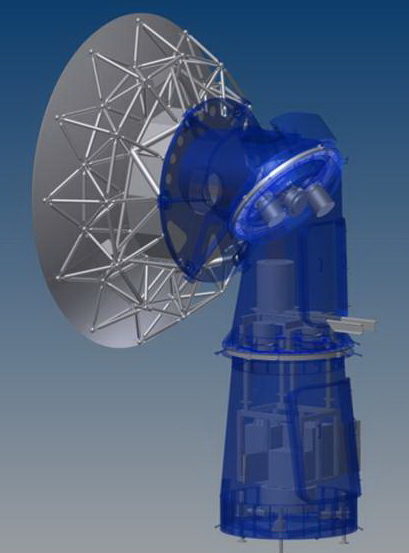
Diagram of a radio telescope that astronomers proposed to be built in Antarctica. |
Astronomers hope to observe electromagnetic waves from the location known as Dome A
Chinese astronomers are applying for government funding to begin construction of a radio telescope in Antarctica that could help solve the mysteries behind stars and galaxies.
The proposed facility, to be built on a giant ice cap known as Dome A, has been designed to observe terahertz, a band of electromagnetic waves normally too weak for ground-based stations to receive.
"The high altitude and low temperatures at Dome A make it possible for astronomical observation of terahertz," said Shi Shengcai, a researcher at Purple Mountain Observatory, a facility in Nanjing affiliated with the Chinese Academy of Sciences. "The thick atmospheric layers in most other places absorb too much of the signal."
Temperatures at Dome A can fall as low as -80 C. The extreme environment is perfect for scientific experiments, but few were able to make use of it before the Polar Research Institute of China and its international partners set up the Plateau Observatory, or Plato, in 2008.
Shi's academy and the State Oceanic Administration now are applying for funding from the National Development and Reform Commission to build a 5-meter terahertz telescope at Dome A. If approved, construction will start soon and last up to five years.
The cost of the project has not been released. However, once complete, the facility is expected to be the only one of its kind on Earth.
The project has been boosted by analysis of multiple terahertz frequencies observed by equipment placed at Dome A over 19 months in 2010 and 2011. A paper on the observation data was published on Tuesday by the science journal Nature Astronomy.
"The initial success is encouraging," Shi said, adding that preliminary research for the terahertz telescope has been completed.
Electromagnetic radiation travels through space in the form of light waves and is distinguished by wavelength. In order of decreasing wavelength, there are radio waves, microwaves, infrared, visible light, ultraviolet, X-rays and gamma rays.
The wavelength of terahertz, which lies between microwaves and infrared, is important in observing the features of the dominant forms of carbon and thus could answer astronomical mysteries related to the formation and evolution of stars and galaxies.
"Terahertz have been a fruitful energy band for astronomical observation, although in the past, scientists had to observe the band using space or airborne telescopes," said Zhang Qizhou of the Smithsonian Astrophysical Observatory in the United States.
The European Space Agency's Herschel, the first space observatory to spot a broadband optical spectrum that included terahertz, was retired in 2013 after providing exciting results in many areas of astronomy.
NASA's Stratospheric Observatory for Infrared Astronomy, a modified Boeing 747SP aircraft carrying a 2.5-meter telescope, can be used for observation for only about 10 hours during each flight.
In 2008, international partners including China, the US and Australia set up a radiometer in preparation for a High Elevation Antarctic Terahertz Telescope. However, that project was later suspended.
"Astronomers thought it (observing terahertz) couldn't be done on Earth," Zhang said. "In fact, a ground-based observatory has obvious advantages, as it can hold a larger telescope and is much more flexible because astronomers can go there - it's difficult, but it's reachable - to maintain and upgrade the telescope."
Hu Zhongwen from the National Astronomical Observatories, also affiliated with the CAS, said Chinese scientists have accumulated experience in deploying and operating sophisticated equipment in the extreme conditions at Dome A.
"The harsh weather poses severe challenges to equipment there, and it wasn't possible to send people to check and fix it repeatedly, so we developed some measures to ensure the equipment is better suited to the environment," Hu said.
"It would be risky to build large scientific facilities in the polar environment without any experience. Experiments with the spectrometer have gotten us prepared for a larger project."