TCM on the horns of a moral dilemma
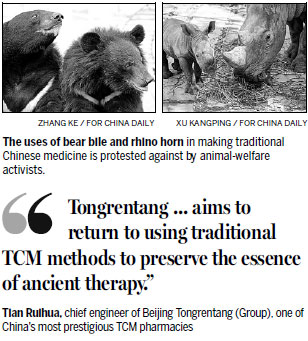
The traditional Chinese medicine industry is facing a dilemma: Should it replace tiger bones and rhino horns used in its medicine to please animal-rights activists at the cost of reducing potential healing effects?
China issued its first white paper on TCM on Tuesday, highlighting both the development of the modern TCM pharmaceutical industry and the traditional roots of ancient therapies.
Animal-rights activists have long raised questions over TCM because many traditional formula contain animal parts or elements extracted from them.
Zheng Jin, head of the Yunnan provincial TCM administration, said that with increased public awareness of animal protection, the TCM industry is promoting the use of substitutes for wild animal parts.
There are generally two ways for making substitutes of animal products in TCM - either finding alternative animals or artificial synthesis, Zheng said.
In January, the scientific development of synthetic muskone to replace that extracted from musk deer won first prize at the China National Science and Technology Progress Awards. The element is widely used in TCM drugs to help blood circulation and treat minor strokes.
Zheng said a number of companies in Yunnan are conducting experiments focused on raising rhinos, as rhino horns are one of the components used in both TCM and medicine in countries in the Middle East and Asia. It is said to help treat typhus and snake poison.
Zheng said that through artificial feeding, companies are able to gather pieces of rhino horn, like trimming a finger nail, with the horns regenerating.
It is now common among TCM doctors to replace rhino horn with buffalo horn, as well as using two other ingredients to replace bear gall. But many TCM doctors say such replacements undermine the effectiveness of the medicine.
A Chinese bear bile company halted its IPO bid twice after animal-rights activists waged a media war condemning it for raising bears and extracting bile from their gall bladders.
Fujian Guizhentang Pharmaceutical, based in Southeast China's Fujian province, has stuck to the use of bear bile in making traditional medicine.
The company has its own bear farm for the extraction of bile from live caged bears via catheters in their bodies. The practice is considered cruel and painful.
Beijing Tongrentang (Group), one of China's most prestigious TCM pharmacies, said it has set up 130 overseas subsidiaries in 25 countries and regions since 1993.
At present, many Tongrentang medicines use synthetics to replace animal elements, including tiger bones and musk.
"The technology for making artificial substitutes is now very mature. The substitutes provide a good supplement," said Tian Ruihua, chief engineer of the company.
"However, as TCM culture is becoming increasingly popular in the West, Tongrentang - as a century-old TCM pharmacy - aims to return to using traditional TCM methods to preserve the essence of ancient therapy," Tian said.