Migrant workers return home to thrive in creative new business enterprises
For decades, China's rural residents have rushed to big cities to increase their earnings, but today, more are avoiding travel and homesickness to make money at home.
The central government released a set of guidelines last week to encourage rural residents to pursue entrepreneurship and innovation.
According to a State Council document, the government will roll out policies to encourage migrant workers to start businesses in rural areas to help economic development there.
Inside a four-story building in impoverished Xinxian county in Henan province, at least 100 women were working to assemble electronic products.
The factory, set up by 46-year-old Tu Guangyong, employs more than 300 "left behind" women, whose husbands have gone to find work in cities, to care for children and elderly at home.
In 1991, Tu started working as a janitor at a factory in Guangdong province, known as the "world's factory", but he was soon promoted to a managerial position.
He resigned and returned home in 2010, taking with him the management and marketing skills he had learned.
"It was getting more difficult and expensive to hire workers in Guangdong. Women in my hometown could provide precious labor resources," Tu said. "It was time for me to go back home and start a factory."
Tu opened three factories near schools. Workers can choose to work between four and eight hours per day, making sure they have enough time for their children who are studying next door.
Thanks to low costs and high quality, Tu's products have been well received at home and abroad.
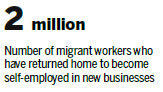
Tuis just one of the 2 million migrant workers who have returned home to become self-employed in new businesses, including large-scale farming, farm produce processing, rural tourism and producer and consumer services.
Returned migrant workers are expected to inject new energy into the rural economy by introducing modern technology, systems and management skills.
Still, many challenges need to be overcome in order for migrant workers to return home, stay and thrive.
"Costs and risks may soar, considering the underdeveloped infrastructure, and the lack of supporting policies and capable employees in rural areas," said Cui Chuanyi, a researcher at the Development Research Center of the State Council.
Cui said the newly released guidelines emphasize equality and support by rolling out measures such as easing market access, improving rural financial services, increasing fiscal support, providing training in entrepreneurship and innovation and perfecting the social safety net.