Forbidden City walls getting major repairs
 |
|
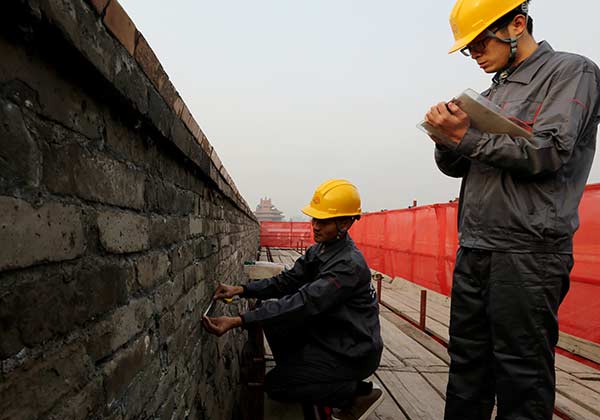
Workers take measurements on Saturday as they prepare for restoration of the walls of the Palace Museum in Beijing. JIANG DONG/CHINA DAILY |
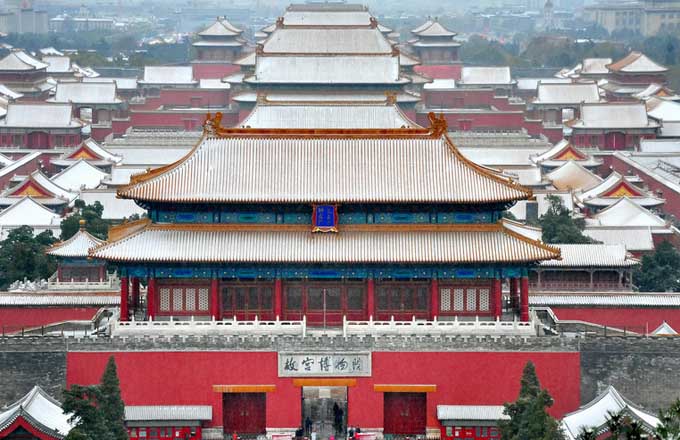
After centuries, walls that once protected mighty emperors are beginning to show their age. The walls of the ancient imperial center of power that is now the Palace Museum in Beijing have weaknesses like loose bricks and bulging, cracking surfaces.
On Saturday, the museum, also known as the Forbidden City, began a restoration project to keep the walls from collapsing.
"People usually think the walls are much more solid than our wooden palace architecture," said Shan Jixiang, director of the museum. "However, the result of our detailed investigation has told us they are not."
Experts recently finished a survey on the condition of the 3,437 meters of wall. It shows hidden hazards: Some sections have been hollowed out over time, and are sagging. Grass and tree roots that have infiltrated gaps pose another major threat to their stability.
The western walls have sustained the most damage, Shan said. A 233-meter section on that side has been chosen as the first target for renovation. Plans for the rest are pending.
The original work on the Forbidden City dates to 1420. Its walls are around 9.3 meters high and 8.55 meters thick. They have an earthen core, protected by outer bricks.
Historical records show there were several major restorations in the 17th and 18th centuries, following heavy rainstorms or earthquakes. In 1988, a section of the north wall collapsed.
In 1999 and 2000, the museum undertook a preventive maintenance project, but it mainly focused on the surfaces. Shan said restorers are looking in depth this time. New, high-tech tools like ground-penetrating radar are being used.
"We want to thoroughly cure the 'illnesses'," he said.
Zhao Peng, a museum engineer who is leading the restoration project, said his team will stick to traditional Chinese construction methods, but he also acknowledged expected difficulties.
"In some cases, it would be easier to use new bricks than reusing materials in the wall to fix the problems," he said. "But the principle of minimum intervention in the restoration of cultural relics demands that we reuse as many original bricks as possible.
"It's thus a challenge to devise a plan to combine and match old and new materials," Zhao said. Any new materials used must conform to the look of the existing brick, he explained.
Shan said he expected the whole project covering all endangered sections to be completed by October 2020, when the Forbidden City celebrates its 600th birthday.