Astrophysics and aesthetics
|
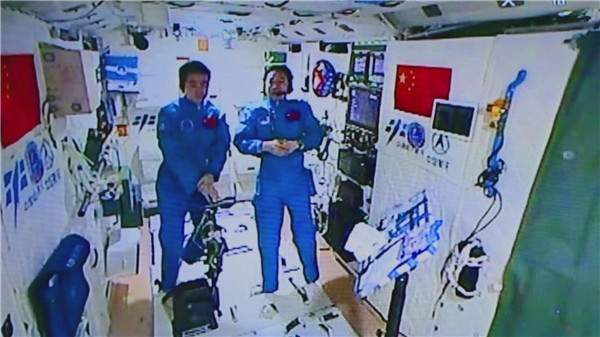
Astronauts Jing Haipeng (right) and Chen Dong aboard the Tiangong II space lab.Xinhua |
Flawless and rare
Zhang's other great love is aesthetics, and he has been studying beauty for even longer than he has been developing satellites.
One of the results of the reform and opening-up policy initiated in the early 1980s was that Chinese people began discussing perceptions of beauty.
"Someone said the Taiwan singer Teresa Teng, who was very popular at that time, was pretty, but others disagreed. I wondered why there was disagreement and what constitutes beauty," said Zhang, who is keen to learn the rules that govern every phenomenon, including aesthetics.
As a scientist, he has studied aesthetics through scientific methods, such as induction, verification, falsification, logic and quantification, and has reached the conclusion that beauty is flawless and rare.
"I can even write a formula for aesthetics. Based on that, we can develop an aesthetic robot in the future," Zhang said, adding that aesthetic robots would have great commercial value because they could be used to select spouses, and in design and architecture.
"Our lives should be aesthetic. If they are not, we will lose the belief that tomorrow will be better and more beautiful than today; we will lose hope," he said.
According to Zhang, the aim of technological innovation is to compensate for the defects of original technology and devise unique inventions.
The goal of scientific innovation is to rectify flaws in original theories and make new discoveries.
Therefore, the essence of scientific and technological innovation is the pursuit of beauty.
"At the same time, scientific exploration is full of surprises that are uncommon. Such scientific achievement is the most beautiful," he said.
Zhang often makes time to take part in activities to popularize science and his theories about beauty, where he cites examples from Socrates to Einstein, from the Big Bang to gravitational waves.
If someone asks about the purpose of studying black holes, Zhang simply answers: "I don't know. I just want to understand black holes."
Most scientific research is useless at first, he said, but the technologies that have the greatest impacts on our daily lives all originated from "useless" science: "We hope China can become a scientifically advanced country. But it will take a very long time."
China Features is a feature department of Xinhua News Agency, which writes indepth stories for overseas readers.