Innovation zone a hotspot for drugs' brave new world
The Zhangjiang National Innovation Demonstration Zone in Shanghai has become a precision medicine development hotspot.
Precision medicine is a bold new research effort to revolutionize methods of improving health and treating disease.
Under this model, medical decisions, practices and products are tailored to the individual patient.
Related diagnostic testing is often used to select appropriate and optimal therapies based on a patient's genetic content or other molecular or cellular analyses.
In short, precision medicine aims to match the right drugs and treatment to the right person.
As part of a national plan to develop such services, several biopharmaceutical companies in the Zhangjiang demonstration zone have focused on developing aspects of precision medicine, such as gene detection and early assessment of tumor risk.
Tumor detection and risk assessment are among the most important parts of precision medicine, including susceptibility gene detection, early screening, diagnosis and evaluation of personalized medication guidance and follow-up services, experts said.
Gene sequencing technology, which involves early warning, prevention and treatment of genetic diseases, chronic diseases and cancer, has been creating more opportunities for early detection of tumors.
Gene sequencing is a scientific way of detecting certain genes, which has become increasingly popular over the past decade.
With a drop of blood or a little saliva, medical staff can predict the risk of a patient suffering certain diseases.
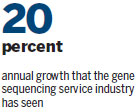
The gene sequencing services industry has seen recent annual growth of 20 percent, and its market size has increased from $8 million in 2007 to tens of billions of dollars, industry sources said.
In the 1970s, the first generation of gene sequencing equipment appeared in the best laboratories in the United States. In the 1990s, scientists completed the first human genome sequencing at a cost of $3 billion.
Since then, the second generation of gene sequencing instruments has been developed.
In 2010, the third generation of gene sequencing instruments was developed and, now, the fourth generation means that human genome sequencing can be done in one day.
More importantly, the cost has been greatly reduced, and is now about $1,000.
At present, there are more than 1,000 medical organizations in the US offering gene sequencing services, from which around 8 million people benefit each year.
In China, the development of the gene sequencing sector is still in its early stages but it is growing quickly and will continue to grow at 20 to 30 percent compound annual growth, industry insiders said.
The Shanghai Precision Medicine Big Data Center, which was established in the Zhangjiang demonstration zone in November 2015, will develop a large intelligent, integrated digital engine, and process and analyze clinical information and varied medical data.
It will establish a clinical data center of major diseases among the Chinese population, a reference laboratory, a large analysis engine for multidimensional biomedical information integration, a cloud computing system, the world's largest big data medical network system and a joint center of molecular medicine.
Officials said the center will play a fundamental role in forming national medical data standards, building an industry service platform, and providing precision medicine systematic solutions and translational studies.
A gene-testing center for high-incidence tumors and genetic diseases has also been established in Zhangjiang. Such a national-level demonstration project will greatly improve the prevention of major diseases, such as genetic diseases and cancers.
|
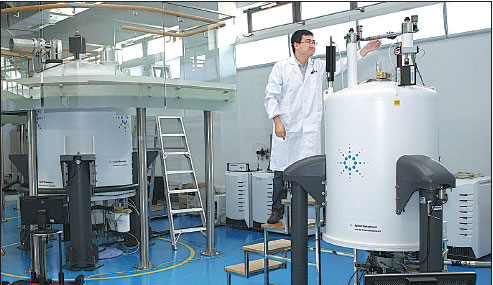
A researcher adjusts a nuclear magnetic resonance system at a biotech lab in the Shanghai Zhangjiang National Innovation Demonstration Zone.Xinhua |