Guideline ends markup on drugs
Patients in China are expected to spend less on drugs at public hospitals and pay higher fees for certain services, according to a guideline released by the State Council, China's Cabinet, to further medical reform in China.
The ongoing medical reform, aimed at improving people's access to health and medical care services, has produced tangible results, according to the guideline.
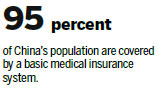
A basic medical insurance system, covering more than 95 percent of the population, has been established, and individual expenditures on health have decreased to less than 30 percent of total health expenditures, down from 40.4 percent in 2008, the guideline said.
All public hospitals will have to stop marking up the price of the drugs they sell, a controversial practice that has been adopted by such hospitals for years to make up for a government funding deficiency, according to the guideline.
Public hospitals generally sell drugs for prices that are up to 15 percent higher than what they pay for them. Some experts say this gives them incentives to buy more expensive drugs, and causes doctors to prescribe more expensive drugs.
With an expected decline in drug sales, the local government will allow public hospitals to adjust service fees. Checkup and test fees will be reduced, while services that require professional skills, such as diagnosis and surgery, will increase, the guideline said.
However, the total cost to individuals will not increase, it added.
In contrast to soaring drug prices, some service fees collected by public hospitals are controlled at very low levels. For example, the price of a diagnosis offered by a doctor with a senior title is no more than 14 yuan ($2.10) in many public hospitals in Beijing, a rate that has not changed for many years.
The local government will make detailed policies to compensate public hospitals for the loss of drug sales revenue, and local governments are encouraged to increase remuneration for medical staff as an incentive, said Liang Wannian, chief for medical reform at the National Health and Family Planning Commission.
"A major difficulty in the medical reform is to break up the strong interest groups that have formed in the medical sector over a long period, such as in drug purchases and distribution," said Wang Hucheng, a medical reform researcher at Renmin University of China.