Older migrants on rise, need help, report says
More policy support is needed to help cities to integrate a rapidly growing number of older migrants, said a report released on Wednesday by the national health authority.
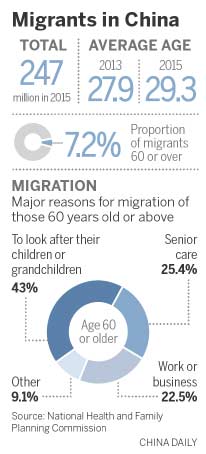 |
The report, based on surveys and monitoring by the National Health and Family Planning Commission, said the average age of migrants has risen from 27.9 in 2013 to 29.3.
"The increase in older migrants reflects China's aging population," the report said. It shows that more are joining their families in "migrant destinations". Most of these are still in the more-developed eastern region, but western areas have attracted a larger share in recent years.
"It is foreseeable that the number of migrant elders will keep increasing," the report said, adding that, "more support and aid" is needed "to help them to better integrate".
Duan Chengrong, a professor of population studies at Renmin University of China, said the trend began to develop about five years ago.
"Society has not paid enough attention to this group, and governments should do more to improve services for them," he said.
Wang Qian, chief for migrant population affairs at the National Health and Family Planning Commission, said the diversity of migrants is putting pressure on governments.
"Previously, migrants were mostly young workers seeking jobs in big cities," he said. "Now, with more elderly joining the group and more families migrating together, they may have different demands, such as housing, medical care and children's education."
The report said 43 percent of the older migrants move to look after children or grandchildren and 22.5 percent migrate for jobs.
Another 25.4 percent move for senior care. Many rely on their children for elderly care, while others find services on their own, including wealthier migrants who move south for the winter.
But for poorer migrants, the move may not stick.
Zhai Junsheng, 61, a migrant worker from Henan province who collects parking fees in Beijing, said he moved a few months ago to join his daughter. Zhai said he has no medical insurance and he is considering going back to Henan soon.
"The biggest problem is lack of room. I cannot afford to rent a house and have to stay with my daughter, but her house is too small."