Astronauts aboard Shenzhou XI have a special companion
 |
|
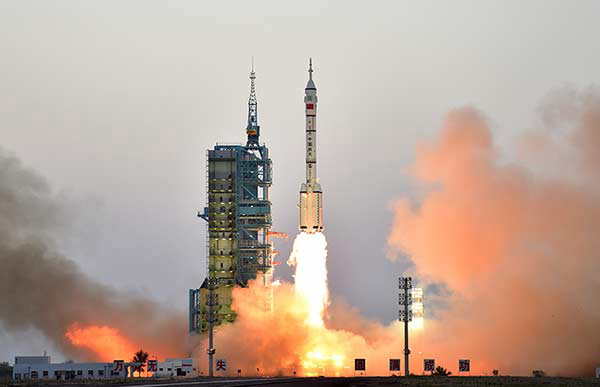
Shenzhou XI manned spacecraft blasts off from the Jiuquan Satellite Launch Center in Northwest China, Oct 17, 2016. [Photo by Feng Yongbin/chinadaily.com.cn] |
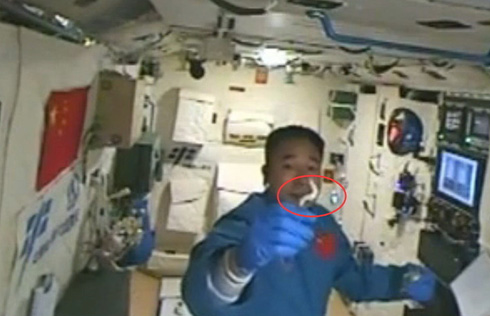
The two astronauts aboard Shenzhou XI spacecraft have an unusual companion: a silkworm.
The insect will be used in an experiment designed by middle school students from Hong Kong.
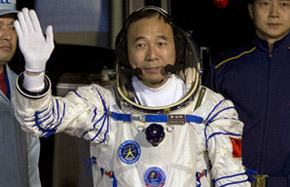
China launched the manned spacecraft carrying astronauts Jing Haipeng and Chen Dong on Monday morning, and it will dock with the Tiangong-II space lab that was launched into space in mid-September.
The silkworm will board on the Tiangong-II space lab in a palm-sized aluminum alloy capsule, and its activities would be viewed through the glass in the middle of the capsule. It is expected to spin and cocoon in space.
Hong Kong students wanted to know if the silk produced in the space will be more thick and tough, and whether such silk could be used to produce special suits, such as spacesuits.
To protect the silkworm from the gravitational acceleration during the launch, scientists used special padding in the capsule, and astronauts will take out the padding after they enter the Tiangong-II.
Scientists also prepared delicious feed with mulberry leaf taste for the worm. Its feed is fixed in caps of the capsule at the two sides, and astronauts will change the caps after the insect empties them.
The inside of the capsule is taped with nonwoven fabrics that will help the worm to climb on the walls in the micro-gravity environment. And the capsule also has some holes for air circulation and cleaning up the feces.
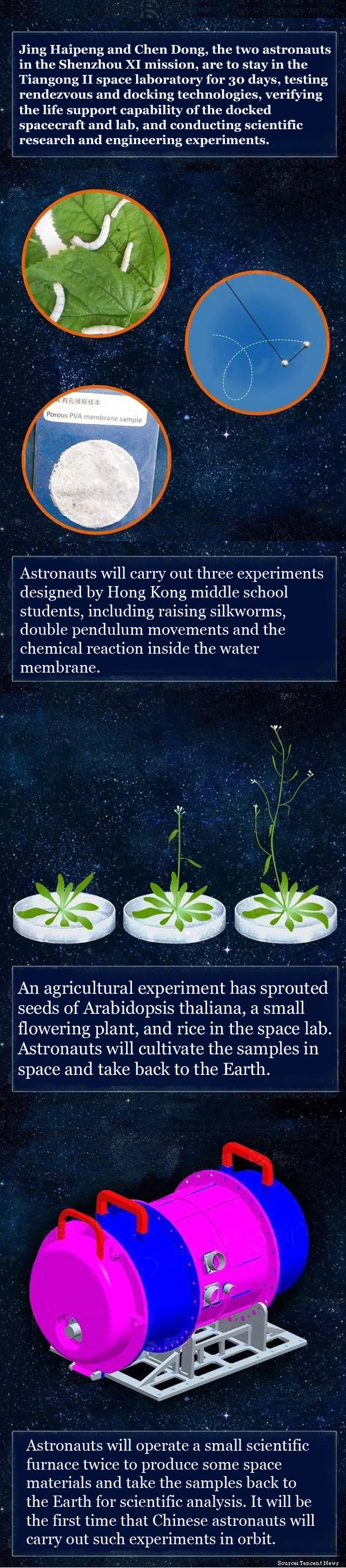
Two other experiments from Hong Kong middle school students include double pendulum movements and the chemical reaction inside the water membrane, an experiment aimed at producing breathable but impervious film.
Astronauts will operate a small scientific furnace twice to produce some space materials and take the samples back to the Earth for scientific analysis. It will be the first time that Chinese astronauts will carry out such experiments in orbit.
An agricultural experiment has sprouted seeds of Arabidopsis thaliana, a small flowering plant, and rice in the space lab. Astronauts will cultivate the samples in space and take back to the Earth.
They will for the first time receive medical ultrasound examinations in the space to monitor their heart and lung functions in real time, an important task to observer the physical effects during long-term stay in space.
 |