In-orbit refueling test proves a success
China has successfully carried out its first in-orbit refueling test, which observers say means it can now prolong the life span of its satellites and spacecraft.
Tianyuan 1, the country's first in-orbit refueling system for satellites, was lifted into space by a Long March 7 carrier rocket on June 25 during the rocket's maiden flight.
The mission also marked the first use of China's fourth and latest space launch center in Wenchang, Hainan province.
Tianyuan 1 has conducted nine in-orbit tests including the control and refilling of liquid in microgravity and accurate measurement of propellant, according to the National University of Defense Technology in Changsha, Hunan province, which developed the system.
The spacecraft recorded video and data when it filled three types of propellant tanks. The results of these tests showed Tianyuan 1 has met designers' requirements, the university said, adding that the system features a high level of automation and stability.
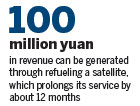
Refueling with 60 kilograms of fuel can prolong a satellite's service by about 12 months, generating nearly 100 million yuan ($15 million) in revenue, the university said.
Wu Peixin, an aerospace industry observer in Beijing, said that due to the technological complexity involved, only a handful of nations, including the United States and the former Soviet Union, have performed in-orbit refueling tests.
"One of the major factors that determines a satellite's life span is the fuel it carries and when it is used. Many satellites were abandoned because their fuel was burned out even though their equipment could still function well," Wu said on Sunday.
"Therefore, in-orbit refueling technology is needed to enable satellites, spacecraft and space stations to work longer. This technology will also allow us to increase the operational range of space probes, helping to realize manned missions to Mars or asteroids."
Wang Ya'nan, editor-in-chief of Aerospace Knowledge magazine, said China operates about 140 satellites in space, so it will benefit greatly once it uses in-orbit refueling technology to service its space assets.
The recent tests performed by Tianyuan 1 will pave the way for large-scale resupply and refueling for China's future manned space station, he added.
As part of China's manned space program, a Long March 2F rocket is scheduled to launch with the Tiangong II space laboratory in mid-September.
In April next year, a Long March 7 is due to transport the Tianzhou 1 cargo spacecraft to dock with Tiangong II.





- Is it a thing? 10 odd jobs where you can make good money
- Message on a bottle: Mineral water company launches drive to find missing children
- Sun Yat-sen champion of national integrity, unity: Xi
- Four killed, two injured after house collapses in C China
- Cross-Straits forum held to commemorate Sun Yat-sen