 |
|
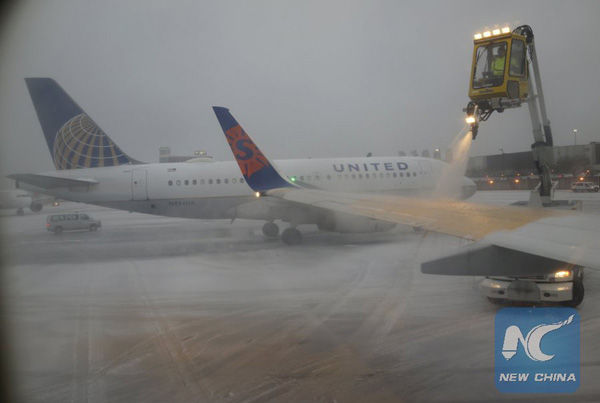
A Sun Country Airlines plane's wing is de-iced as a United Airlines plane waits at the de-icing station during a snowstorm at Logan International Airport in Boston, Massachusetts, United States December 29, 2015. Picture taken through a window. [Photo/Agencies] |
A well-known culprit involved is the so-called supercooled large droplets (SLD) whose maximum diameter is greater than 1,000 micrometers.
So concerned about SLD are safety officials that on Nov 4, 2014, the US Federal Aviation Administration (FAA) enacted a new rule regulating standards in ice buildup conditions created by the presence of SLD.
Yet, despite the known dangers of SLD, significant knowledge gaps remained.
Now, a research team from Shanghai Jiao Tong University conducted an investigation that pointed to a different icing mechanism at work than previously identified.
Led by Professor Hong Liu, the team worked in a closed-circuit wind tunnel, using a self-designed supercooled droplet generator, and a high-speed visualization system to study abnormal ice buildup on planes.
"The thermodynamic effect during the supercooled large droplet impact process has not received sufficient attention. We set out to fill certain knowledge gaps," explained Liu, whose paper was published in the US journal Physics of Fluids.
"The most critical significance of our model is that it reflects the heat transfer quantity generated from the impact thermodynamics. Nowadays, understanding the mechanism of SLD icing has become a significant goal for researchers concerned with air travel safety, so that is our goal in building and testing the most robust model to date."
Test conditions of the so-called Shanghai Icing Wind Tunnel reproduced the meteorological conditions that might be encountered in flight, as well as realistic variable droplet velocities and temperatures.
By reproducing the impingement phenomenon in the lab, they observed rapid-freezing characteristics in droplets that had diameters of 400, 800 and 1300 micrometers.
The results may be used to more closely characterize meteorological conditions to help pilots safely manage flights that encounter freezing rain and SLD-forming conditions, they said.
"Our results indicate that the drop size is a critical factor influencing the super-cooled heat exchange and effective heat transfer duration between the film/substrate interface," Liu said.
"Our detailed experimental results indeed support the safety rationale behind the rule that the FAA recently adopted."
Next, the team will continue to validate and refine their model through SLD icing simulations in the hope of helping improve air travel safety, particularly in icy conditions.



Copyright 1995 - . All rights reserved. The content (including but not limited to text, photo, multimedia information, etc) published in this site belongs to China Daily Information Co (CDIC). Without written authorization from CDIC, such content shall not be republished or used in any form. Note: Browsers with 1024*768 or higher resolution are suggested for this site.
License for publishing multimedia online 0108263 Registration Number: 130349