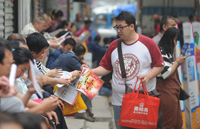
BEIJING - Most Chinese consumers will continue to spend, albeit a bit slower, this year despite slowing economic growth and market volatility, according to research by Boston Consulting Group (BCG).
About three-quarters of Chinese consumers plan to maintain or increase their spending in 2016, down slightly from 81 percent in 2015, according to the consumer sentiment survey conducted by the BCG Center for Customer Insight.
The two principal drivers of growth are that consumers have more disposable income and they are willing to spend more, led by upper-middle-class and affluent households, younger consumers, and those employed in high-paying services, the survey pointed out.
More than 40 percent of Chinese urban households are in the middle class and affluent (MAC) category. Meanwhile, China is seeing the rise of upper-middle-class (UMC) households and small-city MACs, and the emergence of a new generation of younger, happier to spend, sophisticated consumers.
By 2020, UMC and affluent households will have almost doubled to about 100 million and will account for 30 percent of the urban population. The spending intentions of this group will remain constant, and the spending growth rate of 17 percent will be rapid.
Almost 30 percent -- the same as in 2015 -- are planning to spend more this year. A big reason for the spending resilience among UMC and affluent consumers is that half of UMC consumers and three-quarters of affluent consumers are employed in the high-end service sector.
China's younger generation is growing quickly in both numbers and income. Those aged 18 to 30 years old will likely make up more than one-third of the urban population by 2020. Their consumption is growing at a 14 percent annual rate -- twice the pace of the "last generation," those older than 35. The young generation's share of total consumption is projected to increase from 45 percent to 53 percent by 2020.
"Consumption in 2016 will be tantamount to consumers' moving from the fast lane to the middle lane on the economic highway. They are not pulling into the emergency lane," said Jeff Walters, a BCG partner who oversaw the research.
Chinese consumers like to trade up, but the mix of objects of desire is undergoing some transition, the survey found.
Infant and baby products, consumer electronics and financial services remain the top three that consumers are most likely to trade up. Personal care products, such as skin care and beauty, and travel and vacations are moving up the list, too. Cars and durable goods are moving down, perhaps indicating that consumers are postponing big-ticket purchases.
Recent stock market volatility has had little impact on Chinese consumers' daily lives, including consumption, while housing-market stability is a much more critical consideration for Chinese consumers, who continue to be optimistic about housing prices, the survey showed.