 |
|
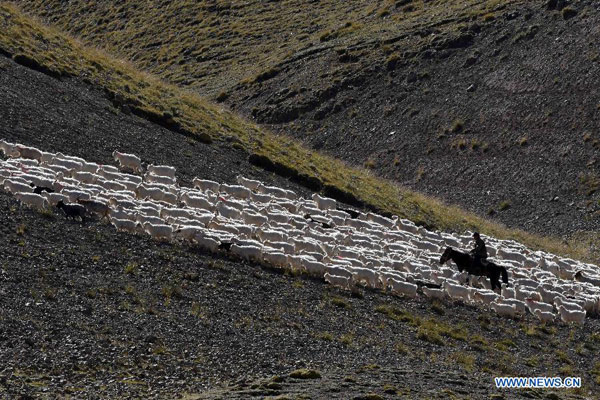
A herdsman transfers his sheep to winter pastures in Hejing county of Bayingolin Mongolian autonomous prefecture, Northwest China's Xinjiang Uygur autonomous region, Sept 3, 2015.[Photo/Xinhua] |
URUMQI -- In China's remote western Pamirs, wealth is measured not in money or houses, but in sheep and cattle.
Every year, the herdsmen move their livestock between summer and winter pastures to "maintain and increase the value of assets."
Kirgiz herdsman Sulayman, 26, lives in Atjiayili Village, the closest Chinese village to the border with Afghanistan, in the Wakhan Corridor, an area with an average altitude over 4,000 meters.
He is going to move 200 sheep to a summer pasture in a valley 25 kilometers away with his family.
The transfer is divided into two groups. One is led by Sulayman, who drives a jeep carrying his mother Aterhan and aunt Gulqal. They will arrive ahead of the livestock so they can set up yurt, prepare food and build the sheepfold.
Sulayman says they must also put up a smaller sheepfold for the lambs. "The lambs have to be separated with their mothers in the evening or they won't have enough milk in the daytime."
The long distance and the high altitude make the transfer of livestock arduous, but the young, weak and old animals are well cared for. Three lambs less than two months old are also taken in the jeep.
In the past, horses were the main form of transport for the herdsmen and their belongings, but the jeeps make the journey easier and quicker, says Sulayman.
On arrival, Sulayman and the two women set up beds and stoves, and then Aterhan makes lunch - yak meat with potatoes, and naan, a staple food of Xinjiang, and a nutritious brick tea.
The other group - uncle Qurbaneli and sister Huryet - is leading 200 sheep. Huryet is taking part in the transfer for the first time. She insists on walking.
At 5:30 p.m., nine hours after they set off, the sheep come into view of the encampment. Sulayman greets his uncle and sister, and counts the sheep - all are present. Sulayman smiles on seeing the sheep in the sheepfold.
From now till October, Sulayman and his family will graze sheep on the pasture and help protect the border. Although they are not professional border guards, they can observe movements there.
May and June are the busiest time in the Wakhan Corridor as herdsmen in Xinjiang Uygur Autonomous Region take their livestock to summer pasture at higher altitudes.
Nomadic herdsmen spend their lives following the water and pasture. The transfer provides cattle and sheep abundant food and enables the grassland to renew itself.
It is near dusk when Sulayman finishes work. He estimates his earnings for the year. "I get a subsidy for help protecting the border. Taking the subsidies and sales of sheep into account, I could earn more than 20,000 yuan ($3,036) for the year," he says.
"As long as the border area is stable, our life is settled."



Copyright 1995 - . All rights reserved. The content (including but not limited to text, photo, multimedia information, etc) published in this site belongs to China Daily Information Co (CDIC). Without written authorization from CDIC, such content shall not be republished or used in any form. Note: Browsers with 1024*768 or higher resolution are suggested for this site.
License for publishing multimedia online 0108263 Registration Number: 130349