When I met Zhai Meixiang in Beidouxi township in Hunan province, she was celebrating her 12th birthday with a group of school friends, who were all left-behind children and shared birthdays in May.
Unlike most girls of her age, Zhai approached her party seriously. When the candles were lit and she made a wish, her face assumed a serious expression as though she were making a life-changing decision.
"If I make the wish seriously, it is more likely to come true," she said.
Zhai made two wishes: that her parents would visit soon, and that they would enjoy good fortune at work.
I asked her: "It's your birthday, so why are all your wishes about your parents?"
She replied, "If they are well, I will be good."
I asked her if she ever complained about her parents leaving her alone at home. "I was not happy at first. But I know they are working hard in cities to provide me with a better life," she answered.
Her maturity broke my heart.
At 12, most girls are just beginning to fight with their parents about wearing nail varnish, or they may be experiencing their first "puppy love" relationship at school. They are usually described as "picky", "bad tempered" and "rebellious".
But for left-behind girls, being young and rebellious is a risky business. They have parents, but a lack of parental care means they grow up extremely quickly.
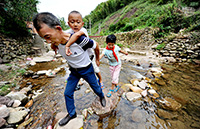
When China started to open up in the late 1970s, the first generation of migrant workers left their homes and children and moved to the cities for work. The first generation of left-behind children has already grown up, and many have repeated their parents' lives, leaving their children at home and heading out to work in cities.
However, few ever become full-time urban citizens. When they begin to grow old and their physical strength fails, they return home to care for their grandchildren who, in turn, have been left behind by their migrant worker parents.
In recent decades, China's economic development has resulted in higher living standards for families in rural areas, which means they have a wider range of options and life choices. Some young parents are able to quit their jobs in the cities and return home to be with their children.
In addition, local governments are more aware of the plight of left-behind children and many have adopted creative approaches to providing care.
In Dushi village, Hunan province, the local government hires volunteers to provide support to left-behind children. One of them, Zheng Lijuan, has taken two children under her wing.
"I visit them every day, and I go to the community center after work. They can always find me there," she said. Her son is boarding at a high school in the township, which leaves her a lot of time to kill.
"I like to spend time with children," she said.



Copyright 1995 - . All rights reserved. The content (including but not limited to text, photo, multimedia information, etc) published in this site belongs to China Daily Information Co (CDIC). Without written authorization from CDIC, such content shall not be republished or used in any form. Note: Browsers with 1024*768 or higher resolution are suggested for this site.
License for publishing multimedia online 0108263 Registration Number: 130349