Warm days come with a downside, as masks can't stop pollutant at ground level in Beijing
 |
|
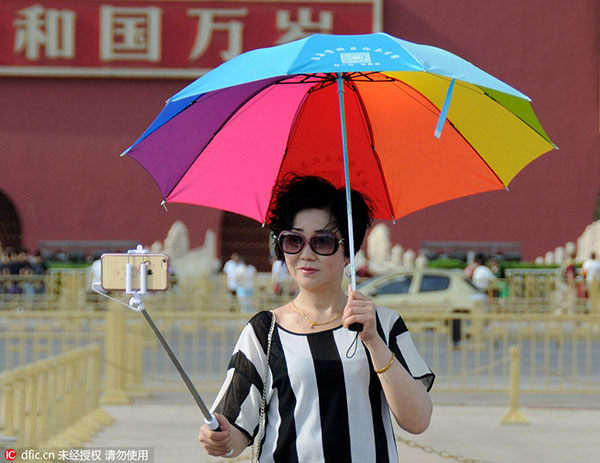
A tourist takes selfie in Beijing, May 6, 2016. [Photo/IC] |
Excessive ozone gas has become the prime pollution problem in Beijing in recent days, replacing the notorious PM2.5, and it's likely to linger for a couple of days, the capital's environmental monitoring authority said on Monday.
Because of the sunshine, many residents may not have noticed that ozone reached an alarming 242 micrograms per cubic meter at 2 pm on Sunday, according to the Beijing Environmental Monitoring Center.
During warm weather, ground-level ozone increases. It is known to harm lung function and irritate the respiratory system. Exposure to ozone is linked to premature death, asthma, bronchitis, heart attack and other cardiopulmonary problems.
On Monday, when clouds blocked the sun, PM2.5 particles returned as the dominant type of pollution in Beijing, the center said. But ozone is expected to return to No 1 on Tuesday and Wednesday.
Different from the protective layer of ozone in the upper atmosphere, excessive ozone concentration at ground level is tied directly to health. Therefore, experts strongly suggest that people stay indoors around noon to avoid the gas, which, unlike particulate matter, cannot be blocked by protective masks.
Ozone at ground level is generated mainly through complicated photochemical reactions. It is closely related to other air pollutants, such as volatile organic compounds and nitrogen oxides. Levels of ozone typically rise at midday due to strong sunshine and higher temperatures, said Chen Nianliang, a researcher at the monitoring center.
Every summer, ozone concentration typically soars from May to August in Beijing, overtaking PM2.5 as the prime pollutant.
PM2.5 refers to particulate matter 2.5 microns or less in diameter that harms health.
Last year, the capital saw fewer than 60 percent of days with air quality meeting national standards in the four-month period, and only 35 percent of days in July had good air quality, according to the Ministry of Environmental Protection. The prime pollutant was usually ozone.
Summer ozone pollution is not a problem only in Beijing; it has grown into a thorny issue nationwide, the ministry said.
In 2015, the average ozone concentration in China's 74 major cities increased by 3.4 percent year-on-year, an increase of 7.9 percent over 2013, especially in the Yangtze River Delta region in the south, said Luo Yi, head of the environmental monitoring department at the ministry, in February.
The complexity of air pollution is increasing and the problem requires more comprehensive efforts, the ministry said.
In Beijing, the environmental watchdog has taken strict control on the emission of volatile organic compounds and nitrogen oxides, the key ingredients in ozone's toxic stew.
In addition, the ministry has pushed measures to reduce ground-level ozone and promoted the success against ozone made by Shenzhen, Guangdong province.



Copyright 1995 - . All rights reserved. The content (including but not limited to text, photo, multimedia information, etc) published in this site belongs to China Daily Information Co (CDIC). Without written authorization from CDIC, such content shall not be republished or used in any form. Note: Browsers with 1024*768 or higher resolution are suggested for this site.
License for publishing multimedia online 0108263 Registration Number: 130349