|
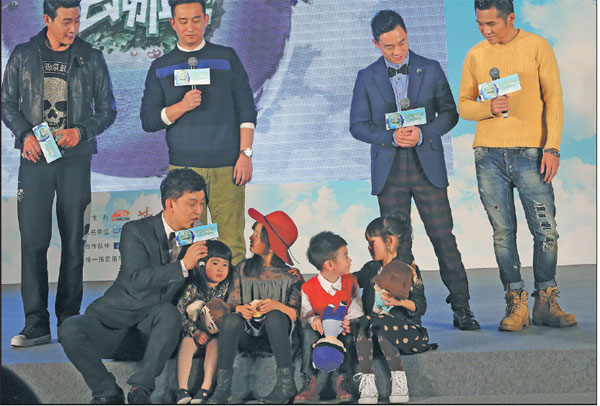
Actor Lu Yi (back row fromleft), actor Huang Lei, Olympic gymnast YangWei and singer Gary Chaw watch their children interact with TV show host Li Rui during amedia briefing for the movieDad,Where AreWe Going? in Beijing on Nov 25, 2014. The filmwas a spinoff of a popular Chinese reality TV show of the same name. Jiang Dong/ China Daily |
China has banned children younger than 18 from appearing in reality TV shows to help them avoid potential problems caused by finding fame at an early age. Wang Yanfei reports.
Few TV programs in China earn higher, or faster, ratings than those showing how parents raise their children, especially when the parent is a chic, well-known celebrity.
Soon though, audiences will no longer be able to see this type of program because the State Administration of Press, Publication, Radio, Film and Television recently banned children younger than 18 from appearing on TV reality shows. The move is designed to avoid the potential pitfalls of "overnight fame", according to a statement released by the administration.
The new regulations are already making an impact on what was a fast-growing industry, resulting in the immediate cancellations of some of the most popular and profitable shows that have sprung up since the 2013 launch of Dad, Where Are We Going?, the first reality show in China to feature children.
Statistics from the nation's media regulator showed that more than 100 entertainment programs were broadcast on national TV last year, and many of them were reality shows that featured children. In total, the programs generated more than 10 billion yuan ($1.5 billion) in advertising revenue.
Based on a South Korean program of the same name, the weekly Dad, Where Are We Going? featured celebrity fathers taking their offspring on camping trips and undertaking assigned tasks, such as cooking meals and building their own shelters, plus bonding by playing soccer and other sports.
The famous fathers came from diverse backgrounds, such as Jimmy Lin, a singer and actor from Taiwan, and diver Tian Liang, who won a gold medal at the 2000 Olympic Games in Sydney.
The first program of the final series, which was broadcast in October, attracted more than 75 million viewers, generated millions of yuan in advertising revenue and spawned a number of spinoffs, including a raft of "how to be a good parent" guidebooks.
After the show's first season, a movie of the same title nett-ed a record 700 million yuan, a feat described as a "box office miracle," by Zheng Qu, a manager with Real Dream Productions in Beijing.
Potential pitfalls
Despite overseeing the publicity campaign for the movie, Zheng now has deep concerns about the format's validity and the potentially adverse effect on the children involved: "Although it sounds a promising and easy track for people in the entertainment industry, making a profit from reality shows involving kids is not sustainable. It's also somewhat inappropriate. Reality shows such as these do more harm than good to the kids involved."
Liao Baoping, a columnist with the Yangtze River Daily, said the growing popularity of shows featuring celebrities and their children may have been the catalyst for the administration's clampdown.
"The audience is curious to see how celebrities raise kids born into rich families, and the producers have made good use of that curiosity," he said. "But the audience doesn't really learn much by watching rich, handsome celebrities and their adorable children playing games in a feel-good countryside setting."
Hunan TV has canceled the fourth season of Dad, Where Are We Going?, and has also stopped broadcasting similar shows, such as Dad is Back and My Mom is a Superwoman, on regular television, although they will be available online.
The producer of a reality show on Hunan TV, who declined to be identified, said that although the new guidelines will result in TV companies losing advertising revenue, they had to be drawn up to protect children.



Copyright 1995 - . All rights reserved. The content (including but not limited to text, photo, multimedia information, etc) published in this site belongs to China Daily Information Co (CDIC). Without written authorization from CDIC, such content shall not be republished or used in any form. Note: Browsers with 1024*768 or higher resolution are suggested for this site.
License for publishing multimedia online 0108263 Registration Number: 130349