II. Radio and Television
Radio and television are accelerating integrated development of content, channels and platforms, as well as operation and management. Corresponding policies are in place, the width and depth of integration have been continuously expanded and more approaches have been explored.
CCTV, for example, started to press forward with media integration in 2015. First, it strengthened top-level design and established a leading group for media integration, changed the former practice of "individual compact" by its various departments to bring into place a new working pattern featuring "all departments playing the same game of chess." Second, it formulated mid- and long-term plans for media integration to clarify goals, key products and programs for each phase of work. Third, it increased financial and human resource input for the integration to strengthen the momentum for development by such means as equity financing. Fourth, it broke the existing mindset, updated development concepts and combed TV-website relations to overcome its present weakness. It sought to cut corners and achieve step change through innovations in institutional terms, production flow, channel building, management framework, operation and personnel training.
1. Program Integration in Full Swing
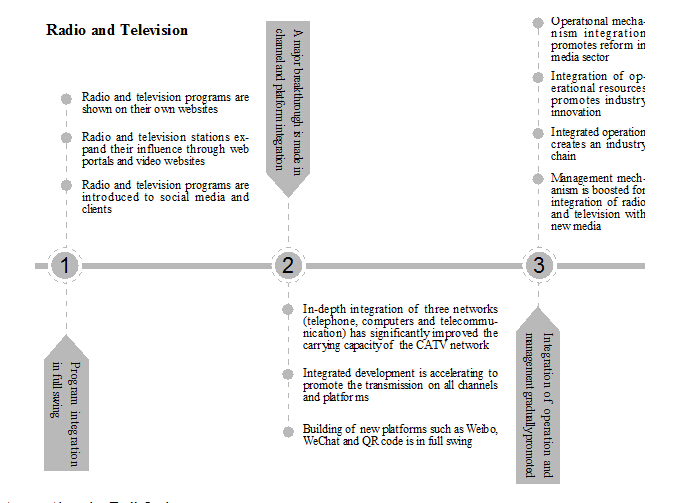
Radio and television program integration has become a common practice, bringing all media transmission into shape. This on the whole increases the influence and spreading capacity of radio and television programs, and feeds content to new media.
Radio and television programs have fully embraced new media.
(1) Radio and television programs are broadcast on their own websites. Radio and television stations above prefecture/city level have mostly set up their own audio-visual websites. There are 29 online broadcasting stations, creating a massive network platform. Most radio and television stations upload their programs to their websites and a number of the stations make them transmissible on desktop, tablet PC and smart phone. Some provincial and city stations have explored omni-media transmission, running their programs on Weibo, WeChat, internet, radio, television, mobile TV, and printed newspapers and periodicals, realizing their synergy effect. Some radio and television stations authorize only their own websites to show their quality original programs to maximize the strength of their web platform.
(2) Gaining influence by sorting help of web portals and video websites. Most radio and television stations have reached long-term cooperation with web portals and video websites to extend their audience by exploiting the advantage of internet platforms, so as to produce the so-called double-platform effect of "traditional transmission + internet transmission." The live telecast of the 2015 Spring Festival Gala on iQIYI.com, the only video website authorized by CCTV, was watched online by over 14 million viewers, setting the global record for a live webcast on a single internet platform and claiming a cumulative play time of over 104 million hours and a bullet curtain comments of over 100 million during the live webcast; the "shake your smart phone and get lucky draw" game was played on WeChat more than 11 billion times, and its multi-screen ratings reached 49.6%, 1.2 percentage points higher than the previous year.
(3) Radio and television programs being brought into social media and clients. Radio and television stations and even some individual programs have opened Weibo and WeChat accounts, and developed quality program apps and clients to deliver content to their audience through these platforms. China National Radio (CNR), CCTV, China Radio International (CRI) and many provincial radio and television stations have embraced the practice of releasing news on all platforms, for example, updating reports on Weibo, posting in-depth analysis on WeChat, and providing a multitude of information and video clips on apps. By June 2015, CNR had over 13 million followers on Weibo and over 480,000 on WeChat, and CRI News Radio accounts on Tencent and Weibo had attracted more than 33 million followers. By the end of 2015, CCTV News followers on WeChat and Weibo and its app users had exceeded 200 million, and the accumulative downloads of video app CBox (by CCTV.COM) reached 450 million. Beijing Media Network (BMN) opened 150 WeChat accounts for its 11 channels and 128 columns. Radio station programs above prefecture/city level throughout the country are now broadcast live or on demand on apps such as Radio.cn and ajmide FM.
Radio and television stations are also working with new media to make programs. They jointly conceptualize, separately implement, work under unified guidance, complement each other, and present programs on both platforms. Some stations are building media integration studios to materialize deeper integration of new media and television programs. Some films and TV programs already take into consideration the requirements and features of new media right at the stage of production. During the "two sessions" (the annual sessions of the NPC and CPPCC) in 2015, the CRI special column used UGC concept (User Generated Content) to produce programs. The reporters concerned collected questions from their circles of WeChat friends, set up WeChat groups for delegates to discuss the relevant issues and generate opinions, and ultimately collect these opinions into a special report — a breakthrough in both information availability and expression of views. When cooperating with new media in producing variety shows, radio and television stations apply big data resources to program design, production, broadcasting, marketing and evaluation, turning the audiences into subscribers to offer targeted services.



Copyright 1995 - . All rights reserved. The content (including but not limited to text, photo, multimedia information, etc) published in this site belongs to China Daily Information Co (CDIC). Without written authorization from CDIC, such content shall not be republished or used in any form. Note: Browsers with 1024*768 or higher resolution are suggested for this site.
License for publishing multimedia online 0108263 Registration Number: 130349