 |
|
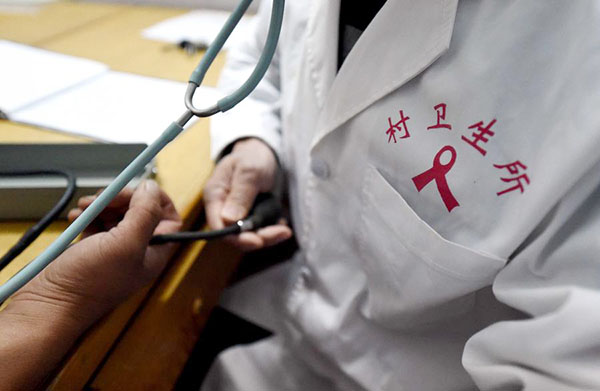
An HIV positive patient, not pictured, receives a blood pressure test in Weishi county, Central China's Henan province in this Nov 30, 2015 file photo. [Photo/Xinhua] |
In a major breakthrough that has the potential to revolutionize the whole fight against HIV/AIDS, Chinese scientists recently modified a gene in embryos in an attempt to make humans immune to HIV virus.
Researchers from the Guangzhou Medical University used a gene editing technique named CRISPR/Cas to replace the CCR5 gene in 26 human embryos with an HIV-resistant mutation. Only four embryos were successfully edited, while the other 22 cases failed to produce the desired results.
The research was reported in the Journal of Assisted Reproduction and Genetics.
"In this study, we demonstrated that the HIV-resistant mutation could be introduced into early human embryos through the CRISPR system," said Fan Yong, a researcher of the Guangzhou Medical University and an author of the paper.
The CRISPR/Cas9 gene editing technique, better known as the molecular Swiss army knife, is a technology developed by US scientist Jennifer Doudna and French scientist Emmanuelle Charpentier in 2012.
Since then, scientists from across the globe have been using the technology to edit animals' gene in the laboratory.
Huang Junjiu, a biologist at Sun Yat-Sen University in Guangzhou, was the first to apply the technique to humans. He reported his experiment on 71 human embryos in Nature magazine in April 2015.
 |
|
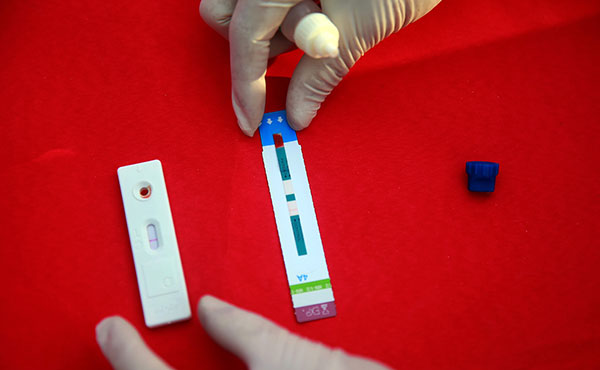
Testing kits that use small samples of blood usually provide a result within 15 minutes. Zou Hong/China Daily |
Despite the fact that Huang's team used embryos from fertility clinics that could not have progressed to live births, their work sparked a global debate on the ethics of such research.
In December representatives from more than 20 countries gathered at a meeting organized by scientists from China, US and UK to discuss these ethical issues.
"Our experiments have gone through an ethical review at our research institute. Unlike the UK, currently China does not have a government authority that accepts and examines applications for this kind of research," said Fan from the Guangzhou Medical University.
Besides editing human embryos, scientists also tried to use CRISPR/Cas9 as a "molecular knife" therapy to cut off HIV within cellular DNA. But a study by Canadian and Chinese researchers published in US journal Cell earlier this month found that the virus can quickly develop resistance to the gene editing technique.
The latest gene editing technique used by Guangzhou Medical University can be traced back to nine years ago when a 41-year-old man dubbed the "Berlin patient", who had both AIDS and leukemia, was on the verge of death. His doctor gave him a bone-marrow transplant from an HIV-resistant donor and miraculously cured both conditions, making him the first person ever to be cured of AIDS.
The remarkable case shed light on CCR5 — a receptor in humans that helps HIV to enter cells — as the bone-marrow transplant changed the patient's gene to a mutation called CCR5-delta32 that blocks HIV.



Copyright 1995 - . All rights reserved. The content (including but not limited to text, photo, multimedia information, etc) published in this site belongs to China Daily Information Co (CDIC). Without written authorization from CDIC, such content shall not be republished or used in any form. Note: Browsers with 1024*768 or higher resolution are suggested for this site.
License for publishing multimedia online 0108263 Registration Number: 130349