China will develop six configurations in its heavy-lift Long March 5 rocket family, which is scheduled for its first flight later this year, said the project's manager.
Wang Jue, head of the Long March 5 project at the China Academy of Launch Vehicle Technology, said the six designs will have different launch capacities. Engineers are currently focusing on the two types that will be used for the Chang'e-5 lunar probe and manned space station missions.
The model that will lift the Chang'e-5 probe will have three stages. It is set to carry out the rocket family's first mission during the fourth quarter of this year, Wang said.
"Though the Long March 5 rockets have already received many domestic orders and will have a tight launch schedule, we also want to seek business opportunities in the international market," he said.
He said that the European Space Agency has expressed an interest in the Long March 5 series' capabilities and competitive costs, but added that the international commercial launch market is affected by many nontechnical factors, so it is too early to forecast the rocket's business prospects.
In February, China concluded the final field tests of a Long March 5 prototype at the Wenchang Satellite Launch Center in Hainan province.
The tests started in last September and occupied more than 130 days. They proved that the Long March 5, the newest and most technologically advanced rocket in China, works well with the ground facilities at the center, according to the academy.
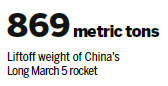
As China's first-generation heavy-lift launch system, the Long March 5 has liftoff weight of 869 metric tons, a maximum payload capacity of 25 tons in a low Earth orbit and 14 tons in a geosynchronous transfer orbit, which is roughly comparable to the United States' Delta IV and Atlas V vehicles.
The rocket will use liquid oxygen/kerosene and liquid oxygen/liquid hydrogen as propellants for its engines, which means the gigantic spacecraft will be friendlier to the environment than previous Chinese rockets.
Once the Long March 5 becomes operational, it will be used to launch large lunar probes and a manned space station that China plans to send into orbit around 2020.
In another development, Wang said his academy has already begun to research reusable rocket technology that has recently become a hot topic after the US aerospace manufacturer Space Exploration Technologies Corp, also known as SpaceX, carried out several tests on its reusable launch system.
Assembly begins on China's lunar probe
Engineers at the China Academy of Space Technology have begun to assemble the Chang'e-5 probe, the third step in China's unmanned lunar exploration effort aimed at landing on the moon and bringing back samples in the next year or so.
Chang'e-5, which the academy says is the country's most sophisticated spacecraft so far, has four modules - an orbiter, lander, ascender and returner. It will use a robotic arm to take samples of lunar soil, the academy said.
China began its lunar exploration program, named for the Chinese moon goddess Chang'e, in 2004. Since then, three probes have been launched. The Chang'e-3 soft-landed on the moon in December 2013, and its rover roamed the lunar surface and performed a host of research tasks.
China also plans to land the Chang'e-4 on the far side of the moon, which will make it the first nation to do so. That mission is set for around 2018.
Engineers have worked out solutions to more than 90 technical problems in the development of Chang'e-5, the academy said, adding these achievements will facilitate the Mars probe project that has just been approved by the government.
China will send a probe to Mars and land a rover on the Martian surface around 2020. A previous effort to explore Mars, a cooperation with Russia, failed in 2011 when a Russian spacecraft carrying Yinghuo-1, China's first Mars probe, crashed into the Pacific Ocean.
Printer to make a mark in space
Researchers conduct a zero-gravity flight test with China's first space 3D printer in Bordeaux, France, recently. The Chinese Academy of Sciences' Chongqing Institute of Green and Intelligent Technology announced on Tuesday that the device, developed by the institute and the Technology and Engineering Center for Space Utilization, successfully passed the test. It could help China build a space station in 2020 and facilitate its operation and maintenance, according to the project team.



Copyright 1995 - . All rights reserved. The content (including but not limited to text, photo, multimedia information, etc) published in this site belongs to China Daily Information Co (CDIC). Without written authorization from CDIC, such content shall not be republished or used in any form. Note: Browsers with 1024*768 or higher resolution are suggested for this site.
License for publishing multimedia online 0108263 Registration Number: 130349