 |
|
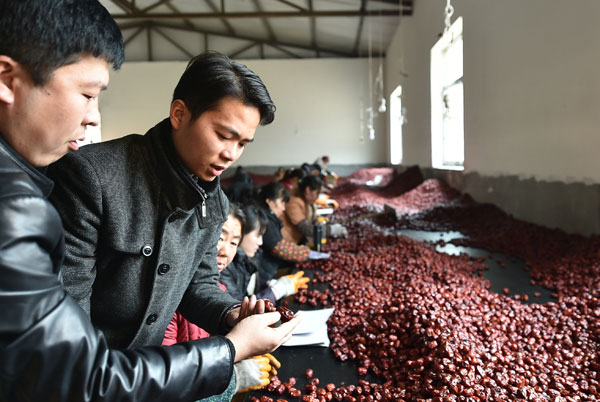
Students from Nankai University examine the quality of jujubes in Shanxi province in March, helping local farmers to sell their products online. [Photo/Xinhua] |
"Nobody ordered them to do so, but the students are very active in starting their businesses. They fully use the knowledge they have mastered and are eager to learn what they don't know. They try their best to cooperate and coordinate with others," Gong, 60, told China Daily. "It's a rare phenomenon in China's traditional education."
The business boom among college students started to build steam in September 2014, after Premier Li Keqiang called for mass entrepreneurship and innovation. In June last year, the State Council announced a string of policies, including financial assistance, to encourage business startups, ushering in a sweeping boom nationwide.
"We should conduct a national survey on the boom to learn about the status quo - such as whether money provided by the government is appropriately used, whether the boom has helped the economy and what problems business starters met, including students' psychological burdens in the process," Gong said.
"It's time to do a comprehensive survey because it's of strategic importance."
Gong said if the current trend continues in China through several five-year plans, "it will change the country's culture and change a generation of young people".
"We'll boast youngsters who dare to think innovatively, to speak out and to carry out, and to take risks," he said. "We'll no longer lag behind the United States in that regard."
Gong said Nankai has established several spaces to encourage the trend. The largest one, which covers more than 5,000 square meters, serves more than 1,000 students in about 70 teams.
In one success story, a group of Nankai students set up an online company to sell jujube stocked in remote mountainous areas of Shanxi province. After solving various difficulties, they sold 1.25 million kilograms between November and early January, with sales revenues of 15 million yuan ($2.3 million). They helped improve the lives of more than 100,000 poor people.
"The team members may not sell jujube for their whole lives. But the experience will make them different," Gong said.

He said encouraging students to start businesses is not about lifting employment numbers: Nankai's employment rate holds steady at around 97 percent each year. It's about something bigger.
"Maybe more than 90 percent of the businesses will fail. But that will be fortunate as a learning experience in the lives of the students," Gong said.
Although many Chinese parents hope their children will get a stable job - in the civil service, for example - upon graduation, Gong said stability should not be the primary value of the new generation in China.
"Following that route, China will not become an innovation-driven country," he said.
Still, he stressed that students' business startups should be based on rigorous study on campus.
The phenomenon at Nankai is only one corner of an entrepreneurial boom across China.
Minister of Science and Technology Wan Gang said in January that there are more than 2,300 maker spaces and about 2,500 technology business incubators nationwide, offering more than 1.8 million jobs.
Two-thirds of the new organizations are said to have emerged in 2015, while there are only 5,300 such organizations abroad.



Copyright 1995 - . All rights reserved. The content (including but not limited to text, photo, multimedia information, etc) published in this site belongs to China Daily Information Co (CDIC). Without written authorization from CDIC, such content shall not be republished or used in any form. Note: Browsers with 1024*768 or higher resolution are suggested for this site.
License for publishing multimedia online 0108263 Registration Number: 130349