 |
|
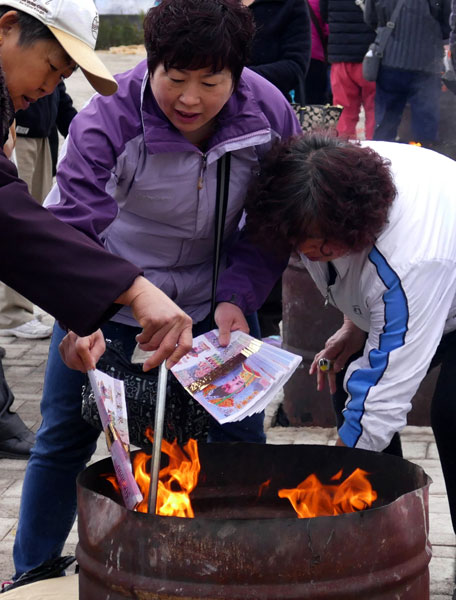
People in Beijing burn symbolic paper money outside a cemetery park as offerings to their deceased relatives on April 2, 2016 during the Tomb Sweeping Day holiday. [Photo/China News Service] |
The paper "money" featuring the former US president sometimes appears among the reams of bills traditionally burned as offerings to deceased family members. Portraits of Mao Zedong are the most popular on the imitation currency, but Washington is also in demand, as are such modern images as South Korean pop star Song Joong-ki, who recently won fame in China with a performance in the TV series Descendants of the Sun.
However, the paper offerings, some of which bear a phrase meaning "Bank notes for the afterlife", might be seen less in the years to come, especially in the capital, because of local regulations and national laws.
The national law that might impact the offerings prohibits the printing of anything resembling the Chinese renminbi. Fines can be levied as high as 50,000 yuan ($7,700).
A local regulation in Beijing bans the printing and selling of all such offering notes, regardless of design.
While the local regulation was introduced in 2001, it was only implemented in recent years.
According to Beijing Youth Daily, law enforcement agencies in the capital confiscated more than 200 kilograms of the notes in the leadup to the Tomb Sweeping Festival.
"We understand it takes a while for the citizens to change their habits, but this has to disappear eventually," said Li Hui, an urban patrol officer in Beijing's Xicheng district. "Burning these papers is really bad for the air and could lead to a large and destructive fire."
Sun Hanyu, a 26-year-old Beijing resident, said his family has not burned the paper offerings for years on Tomb Sweeping Day, but he still likes to put them in front of the tomb as a way to show respect for the deceased.
"I was not aware that these papers were illegal at all," he said. "I think it will not be a big issue for us to abandon these money-like papers, but I would still like to have a tangible way to show my love."
While the capital has been clamping down on burning paper offerings because of safety fears, it has also been urging different kinds of burials in an attempt to save precious space. Sea burials have been gaining in popularity amid official encouragement of eco-friendly alternatives to conventional internment. Beijing's funeral service center scattered the ashes of more than 2,000 deceased people into the sea in 2015, double the number in 2012, according to People's Daily.
Xinhua contributed to this story.



Copyright 1995 - . All rights reserved. The content (including but not limited to text, photo, multimedia information, etc) published in this site belongs to China Daily Information Co (CDIC). Without written authorization from CDIC, such content shall not be republished or used in any form. Note: Browsers with 1024*768 or higher resolution are suggested for this site.
License for publishing multimedia online 0108263 Registration Number: 130349