|
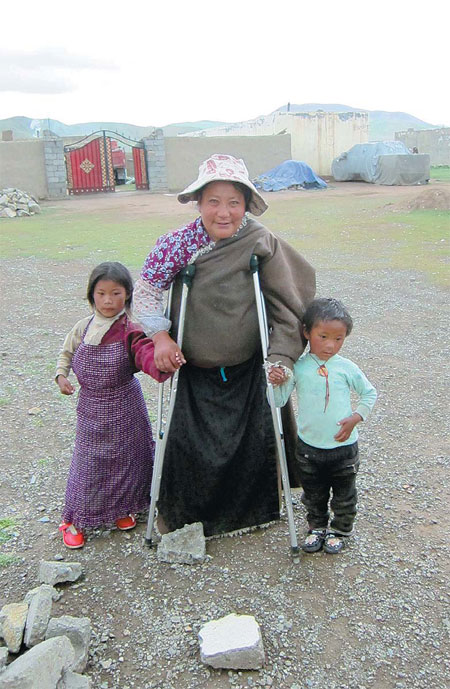
Disabled nomads face the gravest challenges accessing healthcare in Yege township, in Qinahai province's Yushu prefecture. Erik Nilsson / China Daily |
Erik Nilsson
takes the pulse of herders' improved medical care in Yushu, Qinghai.Three of Yege's roughly 200 children died of fevers within the past year. That's despite the fact that since 2011 three clinics have opened and an actual doctor arrived - one of three healthcare providers with a medical degree. The nomadic Tibetan township's healthcare has progressed dramatically since it first short-lived pharmacy closed in 2011. Yet local healthcare remains underdeveloped. Three years ago, a young physician started the first clinic, offering about 100 Tibetan remedies. Another 5 percent were Western medicine.
His most advanced instrument was a stethoscope.
But his business produced huzzas from the 2,000 remote yak-herders in the township in Qinghai province's Qumalai county. However, he left within a year. He felt Yege to was remote and rustic.
"It's hard for me to get used to life without fruits or vegetables," the clinician, Chaoguo, told China Daily in 2011.
The new public clinic's stock is 85 percent Western and 15 percent traditional Chinese medicine.
"The health situation wasn't good when I arrived," says Quezhubtsering, who has headed the public clinic since 2011. (The other two clinics in the township are smaller and private.)
The 31-year-old, who like many Tibetans has only one name, arrived in December 2011.
"Most local health professionals weren't qualified," the doctor says.
Quezhubtsering says his department has given examinations and offered medicine to 80 percent of locals.
National policy dictates locals can get an 80-percent reimbursement from the clinic if they show their medical cards.
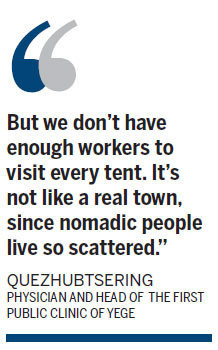
"But we don't have enough workers to visit every tent," he explains.
"It's not like a real town, since nomadic people live so scattered."
Director of Yege's human resources Resang says: "The government provides money for their hospital visits. But they can't go."
The government also provides houses and food for the poorest herders, he adds.
"Some of the most impoverished families have intergenerational problems, like severe illness," Resang says.
He cites as an example a remote family that has two disabled children. The 13-year-old boy "can only move a little" and the 14-year-old girl can walk supported by a wall. Their 1-year-old boy died from a fever last year.
Resang explains inaccessibility remains a two-way problem with many locals who qualify for assistance.
"There are some people we want to help but just can't reach," Resang says.
"There's no road. We walk for hours. But it's dangerous. There are wolves and bears."
Now the clinic has a van. But that doesn't help off-road in the mountains, and the weather often renders roads impassible.
The three biggest respective health issues are back and knee problems resulting from the 4,500-meter altitude, hepatitis and cancer, Quezhubtsering says.
The main ailments Chaoguo identified in 2011 were hepatitis, food-borne stomach diseases, and frostbite and severe joint pains caused by the cold.
Temperatures trough around -25 C and winter lasts 10 months.
A big change in early 2013 was that the prefecture and county government sent real doctors to the village.
But medical workers, permanent or temporary, are stretched thin, Quezhubtsering says.
Only three of the clinic's eight permanent medical workers graduated from medical universities.
Others are nomadic volunteers with 5-yuan monthly stipends.
"They can read and write but don't know medicine," Quezhubtsering says.
"I wish they could study somewhere."
Quezhubtsering is the only full-time doctor.
There are two smaller private village clinics with experienced pharmacists. Workers are unsalaried but earn money through medicine sales.
Most villagers go to the private clinics for diagnoses and to the township clinic for medicine, where they can get reimbursements.
But students are covered for free, Quezhubtsering says.
Still, the medical workers also need to study - and the clinic needs coal, he says.
"We realize nomads are low-income and their children need to go to school," Quezhubtsering explains.
"Education and health are inseparable."


Copyright 1995 - . All rights reserved. The content (including but not limited to text, photo, multimedia information, etc) published in this site belongs to China Daily Information Co (CDIC). Without written authorization from CDIC, such content shall not be republished or used in any form. Note: Browsers with 1024*768 or higher resolution are suggested for this site.
License for publishing multimedia online 0108263 Registration Number: 130349