 |
|
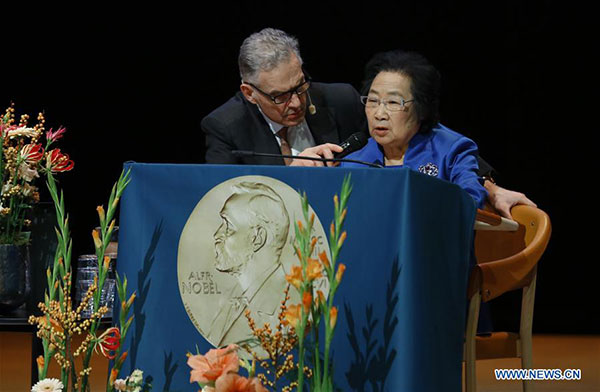
China's Tu Youyou (R) who won 2015 Nobel Prize in Physiology or Medicine gives a lecture in Karolinska Institutet, Stockholm, capital of Sweden, Dec 7, 2015. [Photo/Xinhua] |
A funny thing happened between China's first female Nobel Prize winner giving her acceptance speech in Sweden and that speech reaching her home country: Two entirely different versions appeared, and the fake one became a viral hit.
Considering we're living in an age when a message from Europe need not require someone to ride on horseback for a month or a pigeon to fly eastward for God knows how long, it was simply amazing that such a thing could happen, especially because Tu Youyou has been in the spotlight and almost every word she utters publicly is being reported.
Guess which version is genuine? The one that matter-of-factly recounts the discovery of artemisinin, or the one with extravagant literary flourishes, complete with her father explaining the origin of her given name and poetic lines such as, "I like tranquility, tranquil as the leaves of sweet wormwood; I shun the spotlight, just as the petals of sweet wormwood do; I aspire to be upright, as are the stems of sweet wormwood."
Well, sweet wormwood is the plant from which Tu and her fellow scientists successfully extracted artemisinin. Most readers were so touched by the literary version they were left in tears.
They just forgot that Tu is not a woman of letters, but one of science. It was totally made up by someone who obviously has great literary talent, but could not fathom the inner life of a scientist. I have not met a great many scientists, Chinese or foreign, but the ones I talked to invariably impressed me as no-nonsense and would not cloak themselves in purple prose.
I don't know who fabricated the Tu speech, or for what purpose. It does not strike me as a parody. Fortunately, no mainstream media seemed to have been fooled. Yet the fake one has probably been retweeted more than the real one because it played to the Chinese stereotype of what such a speech should be.
Early this year, when Yu Dan, a celebrity scholar specializing in Chinese culture, publicly quoted from a speech ostensibly made by the Emperor Guangxu (1871-1908), she fell right into the trap of apocryphal text. That particular speech was actually from a historical novel, written by an author who had meticulously studied the reform-minded emperor's thoughts.
However, the author employed poetic license with one detail: when the emperor was supposed to have given that speech, he was already under house arrest by the Empress Dowager.
Yu should have known better. She was so ashamed, said some, that she did not come out to explain or apologize.
China's cyberspace is dotted with the flotsam and jetsam of educational and uplifting quotes, most of which are attributed to luminaries of all kinds, and quite a lot of them are made up. There is a joke that says the United States' spying network collected and sifted through all the Internet data in China, and found that the Chinese are addicted to such chicken soup, including that from dubious sources.
Copyright 1995 - . All rights reserved. The content (including but not limited to text, photo, multimedia information, etc) published in this site belongs to China Daily Information Co (CDIC). Without written authorization from CDIC, such content shall not be republished or used in any form. Note: Browsers with 1024*768 or higher resolution are suggested for this site.
License for publishing multimedia online 0108263 Registration Number: 130349 

