|
|
Many commonplace technologies in our homes and workplaces are the results of less-than-commonplace research.
The World Wide Web, touch-screen technology, diagnostic X-ray equipment and the Linux operating system are examples of relatively recent discoveries that sprang from one of the least-understood branches of scientific research: Particle physics.
Now, with the Beijing Electron Positron Collider, China's 25-year-old particle collider, about five years away from the end of its working life, the nation's high-energy scientists are thinking big and proposing to make the country the center of global high-energy research within the next 10 years.
They have completed an initial conceptual design for a super-giant facility that will be the world's biggest and most powerful particle accelerator and collider.
"We recently completed the initial conceptual design and have organized international peer reviews. The final conceptual design will be completed by the end of 2016," said Wang Yifang, director of the Institute of High Energy Physics at the Chinese Academy of Sciences, in an exclusive interview with China Daily, published on Oct 29.
"The characteristic of high-energy physics is that wherever the most powerful facility is located, that's where the world's leading researchers will be," he said.
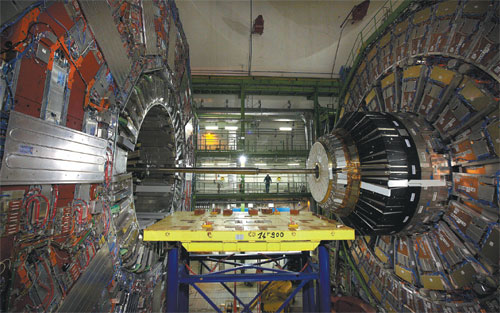
If accepted, the designs produced by Wang and his team will significantly upgrade the largest machine on Earth - the Large Hadron Collider of the European Organization for Nuclear Research, also known as CERN.
"When the LHC was started in the 1990s, China's high-energy physics community didn't have the manpower or material resources to offer CERN a lot of cooperation," Wang said.
In July 2012, CERN announced the most significant scientific breakthrough in decades; the discovery of the long-sought Higgs boson particle, also known as the "God Particle", which is crucial to explaining why matter has mass and is seen as a basic building block of the universe. However, China's contribution was once again limited.
An enduring dream
In the 1970s, when European scientists pitched the concept of the Large Electron-Positron Collider - CERN's 27-km-long accelerator chain that preceded the LHC - China wanted a machine of similar scale.
At first, Chinese scientists approached the government with a plan for a collider of 50 gigaelectronvolts - a minute electrical charge roughly equivalent to the amount of energy an ant expends to take one step - known as a proton synchrotron system. The project failed to get off the ground, though, because the experts were "overconfident about the country's economy" at the time, according to Zhang Chuang, a researcher at the Institute of High Energy Physics who participated in the design and construction of the Beijing collider.
In 1980, Deng Xiaoping, China's then-leader, gave special approval for a fund of 240 million yuan ($1.5 million at the time) to build the BEPC. It was a huge amount of money for the impoverished country, but still small when measured against the cost of research.
The limited budget meant the BEPC's designed circumference was only 240 meters, with a maximum energy level of 2.3 GeV, 50 times less than the LEP collider.
Although CERN was dominant in the field, in 2005 Chinese scientists began considering the future of high-energy physics in the country.
"Again and again, we discussed the nature of the machine we would build when the BEPC was decommissioned," Wang said.
In 2009, China invested 640 million yuan to upgrade the collider, and has since spent 90 million yuan annually on its operation and maintenance. Since then, research into low-energy "charm" physics - a form of high-energy physics focused on studying the "charm quark", an elementary particle - has been a unique field for the BEPC, attracting the attention of hundreds of specialists at home and abroad.
However, the low level of energy constrained its capacity for use in the detection of a wider range of novel particles, such as the Higgs boson.
The BEPC and beyond
Despite its limitations, the BEPC helped China train a large number of high-energy physicists, some of whom gained further experience by participating in world-class research projects, such as those carried out at the LHC. "By 2020, the scientific goals of the BEPC will have mostly been achieved, so we will have a group of world-class, high-energy physicists available for the proposed project," Wang said.
The project will have two phases. The first will involve the construction of a 50-to-100-km-circumference Circular Electron-Positron Collider, or CEPC, capable of generating millions of Higgs boson particles, while the second will be a fully updated version of the LHC, but seven times more powerful.
Compared with the LHC - which took 10 years to build and cost several billion dollars - the proposed CEPC, construction of which could begin in 2020 or 2025, has been designed to ensure that the cost will not exceed the European benchmark.
"About 20 percent of the funding for the LHC came from non-European countries. We are also planning to encourage international cooperation in the CEPC, and hopefully 30 percent of the funding will come from overseas," Wang said.
Nima Arkani-Hamed, from the US Institute for Advanced Study in Princeton, New Jersey, said that in addition to providing overseas funding, the international scientific community "will unite to help in the physics and engineering design aspects of putting the CEPC together".


Copyright 1995 - . All rights reserved. The content (including but not limited to text, photo, multimedia information, etc) published in this site belongs to China Daily Information Co (CDIC). Without written authorization from CDIC, such content shall not be republished or used in any form. Note: Browsers with 1024*768 or higher resolution are suggested for this site.
License for publishing multimedia online 0108263 Registration Number: 130349