 |
In July, Zhang Baohua had surgery for rectal cancer at a hospital in his home province of Shandong. Two months later, he visited a clinic at the Beijing Cancer Hospital for a consultation about ongoing postoperative complications and a severe loss of body mass that had left him weighing just 45 kilograms.
"The doctors told me that it will take time to recover, and that I need to eat. But it's been really hard, especially recently because my stomach has started aching," said the 69-year-old retired factory worker, as he handed a list of his medication to Gu Jin, a renowned colon-rectal surgeon at the hospital.
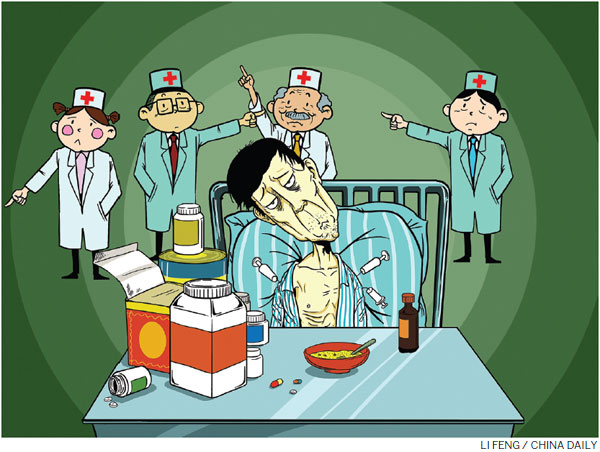
The list contained 13 different types of medication, some of which have to be taken four times a day.
Gu was horrified.
"This is crazy. Anyone who regularly takes this amount of medicine will quickly develop gastric problems," he said.
Zhang blamed the doctors in Shandong. "After the operation, I had problems defecating and urinating, but no one could suggest a reason why. My general condition deteriorated rapidly, too," he said. "At my family's insistence, the attending physician agreed to arrange for doctors from diff-erent departments to see me. My understanding was that they would come together in an effort to discover the cause of my suffering."
That didn't happen. Instead, doctors from the gastric, urological and other departments visited Zhang in the ward individually. "They each asked a few questions before handing out a prescription. At the end of the day, I had 13 types of drugs to take, but I still didn't know the cause of my condition or if it could be cured," he said.
Entrenched views
That approach is typical of most doctors in China, according to Qin Yuan, a physician at the hematology department of the Beijing Haidian Hospital. "'Railway police' - that's what I call them, because they are only interested in their own 'stretch of line'. A deeply entrenched view among Chinese doctors is that they should only be responsible for the part of the illness they specialize in treating. The rest is not their concern," she said.
Liu Duanqi, from the Beijing General Army Hospital, cited political, social and cultural factors for the "highly compartmentalized arrangement" under which doctors are more enthusiastic about working solo than about group discussions and cooperation. "Chinese culture doesn't encourage debate, including debate about the possible treatment of a patient," he said. "This is especially true when dealing with postoperative complications, when the discussions unavoidably involve reviewing the surgery itself.
"There are also financial concerns. Most of the money spent by an inpatient goes to the department in which he or she has been treated, which means doctors from other departments have less incentive to become involved," he said.
Whatever the reason, the practice runs counter to the international trend in tumor treatment. "For a cancer patient, Multiple Disciplinary Treatment, or MDT, has almost become a prerequisite in the West," he said. "It's commonly agreed among medical professionals that the treatment of most types of cancer demands an integrated approach. This is even more true at this time, when the distinctions between disciplines are becoming finer and finer."
Earlier this year, Zhao Hui, a physician who had lived in Los Angeles since 2009, returned to China to start her own business, CancerBioMaster, which assists terminally ill patients and their families and offers "a better life in the face of death".
Zhao, who describes herself as "an agent for cancer patients", acts as a middleman, arranging appointments with leading medical specialists and nutritionists. She believes direct dialogue between doctors lies at the core of MDT.


Copyright 1995 - . All rights reserved. The content (including but not limited to text, photo, multimedia information, etc) published in this site belongs to China Daily Information Co (CDIC). Without written authorization from CDIC, such content shall not be republished or used in any form. Note: Browsers with 1024*768 or higher resolution are suggested for this site.
License for publishing multimedia online 0108263 Registration Number: 130349