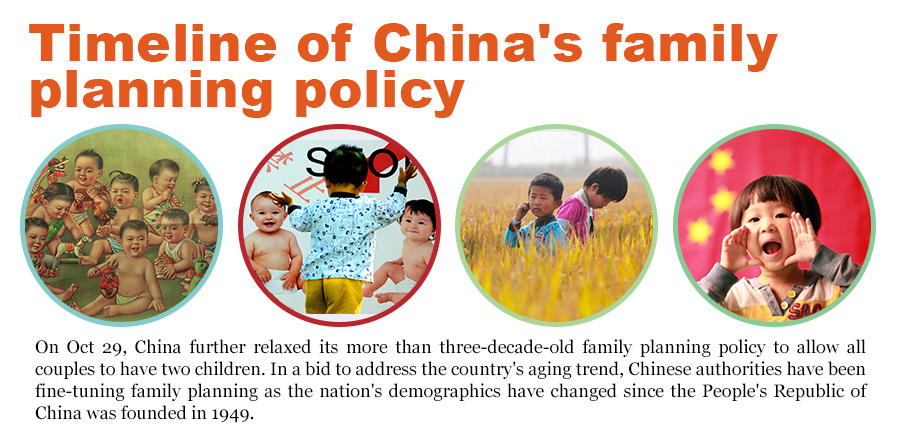
|
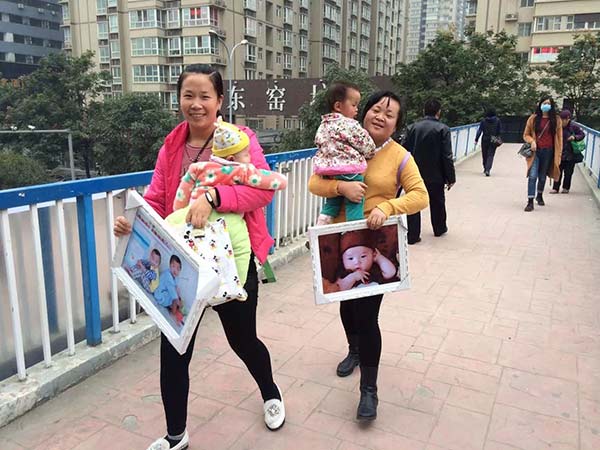 Two mothers hold their babies after getting their photos from a studio on Wednesday in Xi'an, Shaanxi province. The mothers said they are considering having a second child. Hu Guoqing / for China Daily |
A "pileup" of births is expected in the first three to five years after the universal two-child policy takes effect, resulting in two to five million more newborns each year over the time frame, according to experts' estimations.
In the meantime, the fertility rate - the average number of births per woman - would reach 2 during the period, compared to the current less than 1.5, according to Wang Jinying, a professor of economics with Hebei University.
He made the remarks at a symposium convened by the National Health and Family Planning Commission on Wednesday.
More than 10 experts from fields like population science, economics, public administration and women's studies were present.
But after the "pileup" period, the fertility rate would return to around 1.6 and 1.7, which is still far from the 2.1 necessary to replace the population, experts agreed.
Also on Wednesday, Yang Wenzhuang, director of the family planning grassroots guidance department under the commission, said the latest policy will be adopted across China at the same time after amending the National Population and Family Planning Law and its retification by legislators.
Wang said: "The new policy could hardly reverse a downward trend of population development. But it's expected to delay the point when China's population peaks at around 1.46 billion by three years to 2029."
Then the population will shrink gradually and is estimated to be about 1.39 billion by 2050, he projected.
However, that figure would be about 1.3 billion without the universal two-child policy, he said.
Zhai Zhenwu, director of the China Population Association and dean of the School of Sociology and Population Studies at Renmin University, said that based on the calculations it's now the right time to allow for two children, particularly in regards to the future labor supply.
The first babies to be born because of the latest policy would start to join the workforce by 2030, when the population would peak and begin dwindling, he said.
According to Zhai, 60 percent of the 91 million couples targeted by the policy are rural people who usually are willing to have more children than city dwellers.
"They are more likely to take advantage of the new fertility policy," he said.
The previous policy relaxation in 2013 allowing couples with one spouse being an only child to have a second child was not as well received as expected because it mainly impacted urbanites, he added.
shanjuan@chinadaily.com.cn


Copyright 1995 - . All rights reserved. The content (including but not limited to text, photo, multimedia information, etc) published in this site belongs to China Daily Information Co (CDIC). Without written authorization from CDIC, such content shall not be republished or used in any form. Note: Browsers with 1024*768 or higher resolution are suggested for this site.
License for publishing multimedia online 0108263 Registration Number: 130349