 |
|
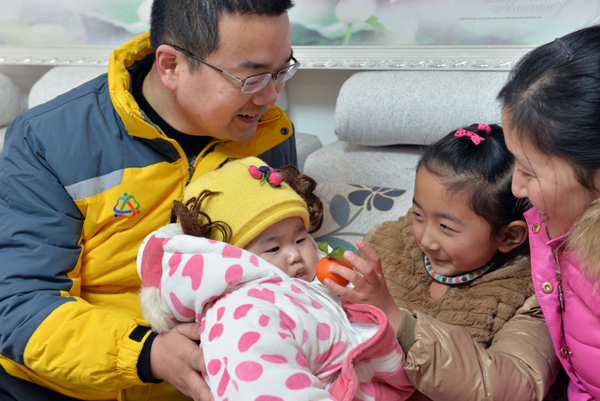
Zhang Xi and Han Wulin, both 30 years old, in Yichang, Hubei province, play with their two children in March. Han gave birth to her second child last year. LI CHUANPING/CHINA DAILY |
A more relaxed population policy is unlikely to boost the nation's birthrate, while other policies, such as encouraging women and seniors to work, are critical to curb the problems of an aging society, according to the International Monetary Fund.
The comment came as the Chinese government allowed all couples to have two children, after long-standing pressure that the restrictive population policy, if maintained, would damage China's population structure, undermine its potential GDP growth and cripple the pension system.
"The pronatalist policies seem to have only modest effects on the number of births. For example, in Germany, policies to encourage births in the 1970s had only short-lived effects, and the introduction of parental allowances did not have a noticeable impact on the fertility rate, which remained at 1.35 (births per woman) over the past decade," Victor Gaspar, an economist at the IMF, said when the study was released on Friday.
The IMF did not give an exact projection of how the new policy would lift China's fertility rate. The report, however, focused on how different policy options would affect age-related spending by 2050 and 2100.
Based on the latest United Nations population projection, a higher fertility rate for developed countries could reduce pension and healthcare spending from 21.4 percent of GDP to 20.6 percent by 2050. However, increasing the labor force participation of women would help more, reducing spending to 20.1 percent by 2050. Other options, such as higher migration, more labor participation of seniors and a higher retirement age would have similar effects.
The result is similar in less developed countries, and adopting these changes would exert a far greater impact by 2100 than by 2050.
For China, the IMF found that increasing fertility would only cut pension and healthcare spending by 0.6 percentage points by 2050. Increasing women's participation in the labor force would cut 0.7 percentage points, and increasing senior participation in the labor force would cut 1 percentage point.
The report cautioned that demographic changes have happened much faster than projected, and past projections had proved far too optimistic. Already, UN projection has been heavily bashed, as its median forecast of China's fertility by mid-century is 1.75--China's fertility now has already dropped to between 1.4 to 1.5.
"From a human rights perspective this is very good news," says Patrick Gerland, a demographer with the UN population division. "But it will hardly have a major long-term effect on population growth in China, where many women are now more concerned about jobs and careers than is reconcilable with having a large family."
Economists have called for greater efforts, other than a two-child policy, to address the dire consequence of an aging population. For example, China International Capital Corp said that if the retirement age was raised by one year every five years, in 30 years the retirement age would be raised from 56 to 62 and the pension fund deficit as a ratio of GDP would be cut by 33 percentage points.


Copyright 1995 - . All rights reserved. The content (including but not limited to text, photo, multimedia information, etc) published in this site belongs to China Daily Information Co (CDIC). Without written authorization from CDIC, such content shall not be republished or used in any form. Note: Browsers with 1024*768 or higher resolution are suggested for this site.
License for publishing multimedia online 0108263 Registration Number: 130349