Wang Yuan, a teacher in a township kindergarten in Xuzhou, Jiangsu province, is ideally placed to witness the fall in China's birth-rate.
Five years ago, she recalled that there were about 40 children per class. Now, Wang said there are just 30 in the class for 5-year-olds and about 20 in the class for 4-year-olds. The figure is just 10 for the class of 3-year-olds.
This sort of anecdotal evidence is being backed up by hard statistics. By the end of last year, there were 225 million Chinese who were 14 years old or younger, which was 16.5 percent of the total population.
That was slightly down from 2011 when the country's sixth national census found the ratio was 16.6 percent. But that number was considerable less than the 22.89 percent in 2000 when the fifth census was released.
According to the global consensus, a country with 15 to 18 percent of its population at 14 years old or younger is considered a "severe low-birth rate society".
Naturally, the figures have triggered a debate in China. Academics, including Mu Guangzong and Liang Jianzhang of Peking University, and Yi Fuxian of Wisconsin University, have argued that the family planning policy must be stopped immediately.
In fact, they say, the government should roll out a "population revival" scheme to avoid China falling into a low birth-rate trap.
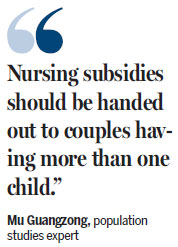
"Nursing subsidies should be handed out to couples having more than one child," Mu said. "Other benefits should include longer maternity leave for parents, and easier access to education and health services. Having two children would be good, but three would be even better."
Already the country's aging population is having a huge impact on industry.
Last year, the labor force continued to contract with the working population of 15 to 59-year-olds down 0.6 percent, according to National Bureau of Statistics.
Even the number of migrant workers was static in the first nine months of this year from 1.9 percent growth in 2014 and 2.4 percent growth in 2013.
Shortages in the work force have already been felt in key industrial cities on the Chinese coast. In the eastern city of Zhangjiagang, home to China's largest privately owned steel mills in Jiangsu province, migrant workers and their families make up more than 40 percent of the population, according to Yao Linrong, a leading city official.
When asked what was Zhangjiagang's greatest challenge in the next five years, Yao replied: "It has to be population. We need a stable population to keep the economy growing."
At the Yonggang Group, the second largest privately owned steel maker in the country, only a few of its workers are "local" even though the company generated 35 billion yuan ($5.5 billion) in revenue last year.
Nationally, the picture is just as grim. China's total fertility rate has fallen to 1.4, well below 2.1 minimum required to replace an aging population. If that trend continues, the population will shrink by 36 percent in a generation, experts said.
Many regions face even lower birth rates. Shanghai, for example, has the lowest TFR of 0.86 for the last-decade, while the sixth census found that the northeastern region had a rate barely above 1.
Last year, the government allowed couples to have a second child if either of them is the single child in their family. Of the 11 million couples eligible to have a second child, only 1.45 million nationwide have applied for permission.
Ed Zhang contributed to this story.


Copyright 1995 - . All rights reserved. The content (including but not limited to text, photo, multimedia information, etc) published in this site belongs to China Daily Information Co (CDIC). Without written authorization from CDIC, such content shall not be republished or used in any form. Note: Browsers with 1024*768 or higher resolution are suggested for this site.
License for publishing multimedia online 0108263 Registration Number: 130349