 |
|
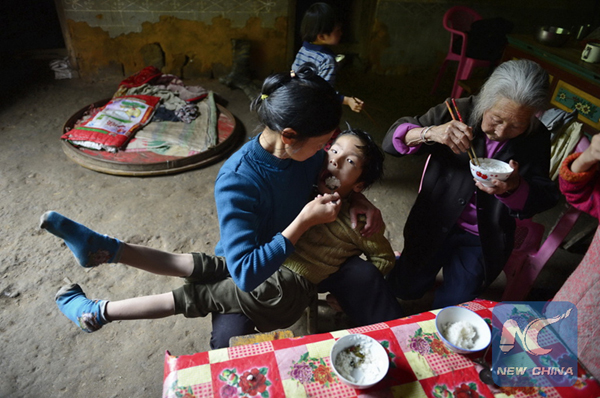
A poor rural family in east China's Jiangxi province. [Photo/Xinhua] |
BEIJING - Despite years of prosperity in eastern China, pockets of poverty still remain in the developed region.
While east China is home to affluent metropolises like Beijing and Shanghai, carving out and lifting up the impoverished areas in the region presents a special challenge for the country's resolution to eliminate poverty by 2020.
Zhang Changyong is living in Yingshang county in the Dabie mountains on the border of Hubei, Henan and Anhui province, one of the poorest regions in the East. Even though his mud-walled house is equipped with electricity and lights, his house remains dark throughout the day. He simply cannot afford power.
Two hours' drive from Hefei, capital of Anhui province, Yingshang seems "prehistoric" to urban dwellers in the east.
Besides his house, Zhang's family's only possessions are a few pieces of worn-out furniture scattered across the mud floor. After Zhang's son died from illness, his daughter-in-law fled, leaving three children behind.
Unable to support her granddaughter's college education on meager earnings from farm work and an annual government allowance of 3,000 yuan ($472.5), Zhang's wife Shan Congzhen, who's in her seventies, has to scavenge the village. When lucky, Shan can earn 10 yuan in two days.
According to the civil affairs bureau of Shangying county, there are more than 10,000 impoverished households like Zhang's in the county.
Dabieshan is one of the country's 11 "extremely impoverished" regions involving multiple towns and villages. Nearly two million people need financial aid in Anhui alone. Several of the "extremely impoverished" regions are located in east China including Anhui and Jiangxi provinces.
Zhang Xiaoshan, director of the Rural Development Institute of Chinese Academy of Social Sciences (CASS) said battling poverty in the 11 extremely impoverished regions is a major obstacle in poverty relief efforts.
"Most of these belts lie in provincial border areas, which requires more coordinated efforts," said Zhang.
China has pledged more support policies to lift its poor people above the poverty line by 2020. So far, they have helped lift more than 600 million people out of poverty in the past 30 years, accounting for about 70 percent of those brought out of poverty worldwide.
The poverty rate stood at 7.2 percent last year, much lower from the 73.5 percent in 1990, using the country's poverty line of 2,300 yuan ($376) in annual income by 2010 price standards.
To improve living conditions, infrastructure and public services have been improved in rural areas. More people in poverty-stricken regions have enjoyed better houses, cheap electricity, clean water, improved medical services and education.
China was the first developing country to meet the Millennium Development Goals (MDGs) target of reducing the population living in poverty by half ahead of the 2015 deadline.
To fight poverty in extremely impoverished regions in the east, provincial governments have adopted specific measures including promoting farm products through the Internet and tourism.
Tourism has lifted a total of 446,000 people out of poverty in Dabieshan area in the past five years. It has also proven effective in Jinggangshan in Jiangxi Province.
The local government in Jinggangshan financed construction of modern brick houses for people living deep in the mountains. Once resettled in these modern houses, the poor households turn their new houses into village resorts for urban visitors.
Yu Qiuming, who moved into his new home several years ago, said tourism has raised his family's income by nearly 10 times. Life in the new house provides conveniences such as education and health care, unthinkable for their former residence.
Thanks to a similar relocation project funded by the central government, more than 600,000 households have been relocated to new houses in more accessible areas in southern Jiangxi.
Despite progress, Zhang from CASS said over-reliance on tourism could present a new problem of endangering the ecology in such regions. Young people are also fleeing impoverished areas, undermining poverty-relief efforts.
He said it should be a priority to foster large agricultural households, family farms and cooperatives to retain and attract young people.
Wang Shuobai, a sociology professor with the Anhui University, believes a fundamental way to alleviate poverty is for people in impoverished areas to be able to create fortunes on their own.
One way to achieve that, Wang said, is to enhance vocational training.
Poverty relief will be a major issue for a key meeting later this month to set the course for China's development over the next five years (2016-2020).


Copyright 1995 - . All rights reserved. The content (including but not limited to text, photo, multimedia information, etc) published in this site belongs to China Daily Information Co (CDIC). Without written authorization from CDIC, such content shall not be republished or used in any form. Note: Browsers with 1024*768 or higher resolution are suggested for this site.
License for publishing multimedia online 0108263 Registration Number: 130349