|
 |
China still faces a steep challenge in achieving a normal gender balance, according to an official with the top health authority.
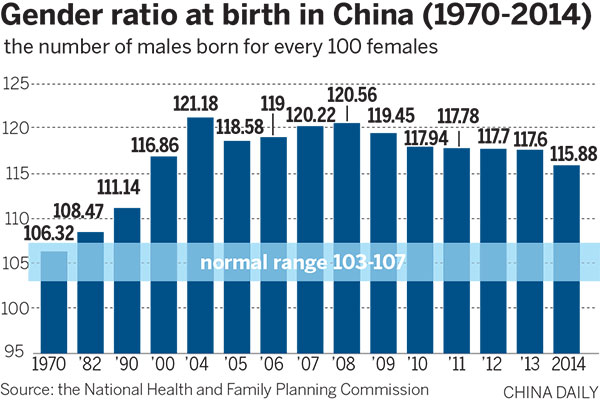
This is despite a continual drop in the nation's highly skewed gender ratio in births over the past six years.
In an effort to remedy the imbalance, the National Health and Family Planning Commission pursued 2,014 cases involving illegal fetus gender identification and gender-selective abortion in the first half of the year, said Zhou Gongwei.
Zhou, head of the commission's Gender Equality Office, was speaking to China Daily in an exclusive interview.
China had set a goal of reducing the ratio of boys to girls, now at 115.88, to below 115, but the target has been hard to meet. "Gender selection is still rampant," said Zhou, whose office operates under the commission's Family Development Department.
In the first half of this year, 42 people were prosecuted for gender selection offenses, and 10 healthcare workers and 14 medical institutions had their licenses revoked, the commission said.
China is one of 18 countries and regions worldwide with a gender ratio among newborns that is above 107, which is at the high end of the normal range of 103 to 107. Other countries include Armenia, India and Vietnam.
The country's gender ratio at birth peaked at 121.18 in 2004. The figure fluctuated at about 120 in following years before beginning to drop after 2008, although slowly.
Zhou said China has suffered the most from the skewed gender ratio and for the longest period, creating a marriage squeeze in which the number of potential brides does not match the number of potential grooms.
"Over the long run, that definitely upsets the country's population security and social harmony," he said.
Boys have long been favored in China. Families, especially in the vast countryside, prefer boys over girls, as men are stronger laborers and, culturally, they are expected to care for and support their parents.
In another effort to restore the gender balance, China relaxed the family planning policy in late 2013, allowing more couples to have a second child. Many believed this would help redress the gender imbalance over the long term, but it could do little in a short period, Zhou said.
Instead, the gender ratio among second babies was far above the national average in some regions, which Zhou did not name. "The figure recorded last year was close to 130 in some places," he said.
A goal for the gender ratio for newborns to fall below 115 by this year was set in the National 12th Five-Year Population Development Plan (2011-2015).
Progress has been slow and the relaxation of the one-child policy has not helped. Over the past four years, the figure fell on average by half a percentage point annually, but the gap was a little higher at 0.88.
Detecting and cracking down on gender-selective abortions has become increasingly difficult with the wide availability and ease of technology, Zhou said.
On the Chinese mainland, the worst nine provincial-level regions reported a ratio of 120 and higher, including Anhui and Fujian provinces, based on population data from the Sixth Population Census, he said.
Sixteen provincial-level areas contributed to two-thirds of China's newborns each year and have been blamed for nearly 90 percent of the gender imbalance.
"They are grouped as the primary target for the ongoing crackdown on underground gender-selective abortions," Zhou said.


Copyright 1995 - . All rights reserved. The content (including but not limited to text, photo, multimedia information, etc) published in this site belongs to China Daily Information Co (CDIC). Without written authorization from CDIC, such content shall not be republished or used in any form. Note: Browsers with 1024*768 or higher resolution are suggested for this site.
License for publishing multimedia online 0108263 Registration Number: 130349