 |
|
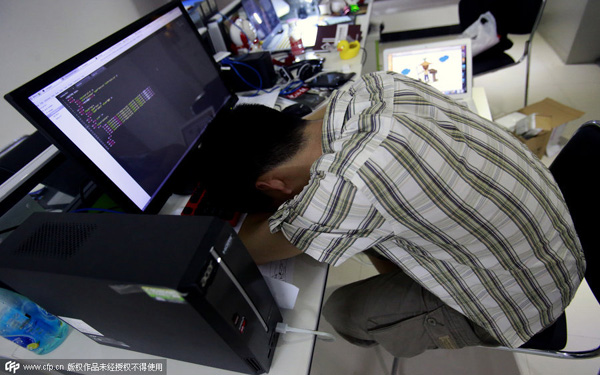
A software developer takes a break in his office in Wuhan, Central China's Hubei province, April 28, 2015. [Photo/CFP] |
Working overtime has become routine for white-collar workers, with more than 60 percent of employees in a recent survey saying they have to work extra time on weekdays and 40 percent having to do so on the weekends.
Nearly 14 percent said they only enjoyed half the weekends off in a month, while 3.4 percent said they had no day off in a month.
The survey was released by leading portal website NetEase. It was based on data from 800 million users as well as results from more than 38,000 questionnaires. Work outside of the 9 am to 6 pm time frame was defined as working overtime.
Guangdong province, Beijing and Zhejiang province have the most employees working extra time from Monday to Friday, while Hong Kong, Shanghai and Jiangsu province have the highest average number of monthly overtime days.
Working such long hours can be harmful to employee health.
Zhaopin, a Chinese human resource website, said in a report that 56.6 percent of white-collar workers have no time to exercise.
Huang Ruoshan, Zhaopin's senior career consultant, said working overtime is only prevalent in certain industries such as real estate, the Internet and finance.
"Those industries are developing very rapidly, which demands employees work hard under pressure and work extra time," said Huang. "Take the e-commerce industry as an example: It actually demands that employees be available 24 hours a day seven days a week."
In the Internet field, there is a term called "996", which means employees start at 9 am, finish around 9 pm and have to work on Saturday.
An employee of mobile phone company Oppo in Shenzhen who only wanted to be identified as Shen, said it is normal to work extra time and he is willing to do that.
"I barely have weekends. However, I am satisfied with my job, my colleagues and working environment. This industry is changing so fast, I am proud to say I am creating value in my position," said Shen, 27.
"However, I know working overtime hurts my health. I even look older than my peers," added Shen. "So I am considering an early retirement when I have enough savings."
According to a report released by Zhaopin in February, getting out of Beijing, Shanghai and Guangzhou has become more popular, with more job seekers considering moving to smaller cities.
Huang, the career consultant, said pressure from hard work and the fast pace of life have driven some job seekers away from first-tier cities.
"Employers have figured out how to keep talent under high pressure," said Huang. "Certain companies provide canteens, exercise facilities and other convenient services. Job seekers can't change the workload, but have to make their choices based on the situation."


Copyright 1995 - . All rights reserved. The content (including but not limited to text, photo, multimedia information, etc) published in this site belongs to China Daily Information Co (CDIC). Without written authorization from CDIC, such content shall not be republished or used in any form. Note: Browsers with 1024*768 or higher resolution are suggested for this site.
License for publishing multimedia online 0108263 Registration Number: 130349