 |
|
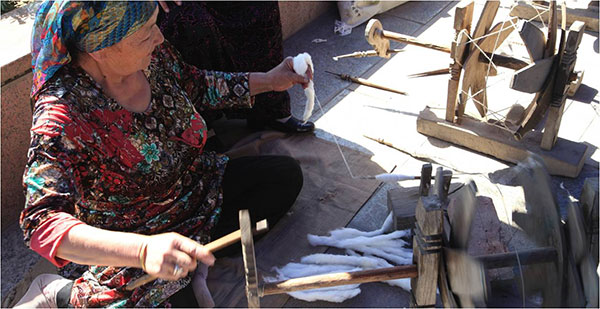
A Uygur woman revives old skills as she weaves silk using a loom as part of a restoration project at the Technological Protection Institute of the Academy of Turpan Studies.[Photo/provided to China Daily] |
The ancient tradition of silk farming could be revived at Turpan in the Xinjiang Uygur autonomous region as part of a project to restore exquisite clothing and other items up to 2,000 years old found in ancient tombs.
The silk products include handcrafted kerchiefs with flower and rhombus patterns, and handbags, and are evidence of how Turpan prospered as a key stop on the ancient Silk Road.
"The unearthing of the silk products from the tombs shows how valuable the silk trade was and how it benefited the people along the road," said Xu Dongliang, deputy head of the Technological Protection Institute at the Academy of Turpan Studies.
Most of the clothes were used to dress the bodies in the tombs and have been damaged as the remains decayed. Experts at the institute face the difficult task of restoring the items. They plan to return 33 of them to their former glory this year with help from German experts.
Now, as the country promotes the Silk Road Economic Belt project as a way of generating new wealth, the source of Turpan's original prosperity looks set to make a comeback.
The academy plans to encourage farmers to produce silk so it can obtain the special type needed for the restoration project.
Silk farming took place in Turpan from the time of the Han Dynasty (206 BC to AD 220) until 1972, when the authorities stopped buying the fiber from farmers because the development of the country's textile industry meant local silk products could not compete on price.
"We have to use silk produced by the silkworm that was formerly cultivated in Turpan to restore the relics because it bears a greater similarity to the ancient silk we have recovered," Xu said.
The institute previously tried to restore the items with silk from Zhejiang province, but the two types did not match. "The city still has a large number of ancient mulberry trees, and this has made the restoration of silk farming possible," Xu said. The trees are the sole source of food for silkworms.
The project could also benefit from a citywide program to boost forestry coverage, in particular the number of mulberry trees. Archaeological findings indicate that the planting of the trees dates back more than 3,000 years.
Turpan unveiled a plan last year to plant 3,333 hectares of mulberries by the end of 2020 in an effort to improve the city's environment. As of last month, 23,000 trees had been planted.
Su Fuli, office director at Turpan's municipal forestry bureau, said the project is intended primarily to protect the city from sandstorms, since mulberries thrive in the city's dry environment and high temperatures.
The trees also give farmers an additional source of income as the fruit can be sold. However, he said, the authority has no plans to encourage farmers to take up silk farming.
Xu said the archaeological evidence shows that silk products and silk farming spread along the road.
"The findings show that the city used to be a major hub for transportation as well as cultural exchanges," he said.
In Turpan, the combination of low rainfall, high temperatures and arid air was a key element in the preservation of relics, especially tombs and the mummies they contain.


Copyright 1995 - . All rights reserved. The content (including but not limited to text, photo, multimedia information, etc) published in this site belongs to China Daily Information Co (CDIC). Without written authorization from CDIC, such content shall not be republished or used in any form. Note: Browsers with 1024*768 or higher resolution are suggested for this site.
License for publishing multimedia online 0108263 Registration Number: 130349