|
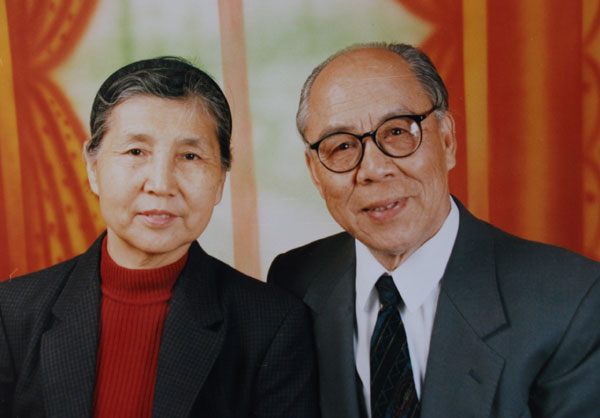
Liu Shiyue and his wife Fu Huimei. Fu, who was born and raised in Japan, moved to China during the Japanese occupation. She became a bridge between Liu and his Japanese colleagues. Provided to China Daily |
Liu's father also survived the war. "My father served in the army as a doctor. He was at a medical center far away from home at the time." Liu said.
According to Liu, his father treated tens of thousands of wounded soldiers: "My father was my role model. I wanted to become a doctor like him and save lives."
When the war ended in 1945, Liu began studying medicine. When he graduated, he served as a general physician during the Chinese Civil War (1945-1950), and later worked as an ophthalmologist at the Bethune International Peace Hospital in Shijiazhuang, the capital of Hebei province, which had originally been an Eight Route Army field hospital for wounded soldiers in the Shanxi-Chahar-Hebei region, an important anti-Japanese military base.
After his wartime experiences, Liu was shocked and deeply unhappy when 120 Japanese medical staff arrived to work at the hospital in 1951. At the time, Liu's hatred of the Japanese was so strong that he had difficulty working with them or even regarding them as colleagues. "Their faces always reminded me of the evil deeds committed by the Japanese troops," he said.
The 120 Japanese included 45 doctors, 34 nurses, eight pharmacists, and a small number of administrative staff, who worked at the hospital until 1953, with several holding top positions, according to hospital records.
Liu's attitude toward his new colleagues gradually changed, thanks to his wife, Fu Huimei, who had been born in Japan and lived there with her parents before moving to China during the Japanese occupation. Fu also worked at the hospital, and she helped her husband to forge friendships with the Japanese visitors.
Fu's superior at the hospital was a Japanese dentist called Kazumichi Inoue, who worked at the hospital for seven years, from 1946 to 1953. Inoue's enthusiasm and masterly treatment of patients won him great acclaim from both soldiers and the local civilian population.
In addition to his routine work on the wards, Inoue also taught. He trained nearly 100 dentists during his stay in China, and many of his former students became the backbones of hospitals in the Beijing Military Region during the 1980s.
Fu spoke Japanese fluently, so she was regularly invited to translate correspondence and records for various hospital departments, including the eye clinic where Liu worked.


Copyright 1995 - . All rights reserved. The content (including but not limited to text, photo, multimedia information, etc) published in this site belongs to China Daily Information Co (CDIC). Without written authorization from CDIC, such content shall not be republished or used in any form. Note: Browsers with 1024*768 or higher resolution are suggested for this site.
License for publishing multimedia online 0108263 Registration Number: 130349