 |
|
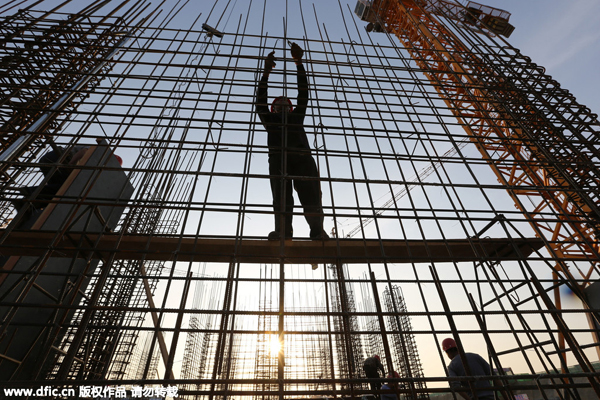
A worker stands on scaffolding on a construction site in Rizhao city, Shangdong province, on April 15, 2015. [Photo/CFP] |
Although the number of migrant workers in China continued to grow in 2014, the rate of increase for the group has fallen consecutively for four years, and their average age is on the rise, causing concern among economists.
The number of migrant workers increased last year by 1.9 percent year-on-year to 273.95 million, a 5.2 million increase from 2013, said a report released by the National Bureau of Statistics on Wednesday.
However, the year-on-year growth rate has been declining since 2010. From 2010 to 2013, the number stood at 5.4 percent, 4.4 percent, 3.9 percent, and 2.4 percent respectively.
Around 43.5 percent of migrants in 2014 are over 40 years old, compared to 34.1 percent in 2010, and 30 percent in 2008, government data show. The average age of migrant workers grew from 35.5 in 2010 to 38.3 last year.
"In the future, the percentage of migrant workers under 40 will further decrease, and this is a warning for China's labor-intensive manufacturing industry, which needs to accelerate technological upgrades," said Li Zuojun, a senior researcher at the Development Research Center of the State Council, according to Economic Daily.
"Urbanization is a reason for the decline. In some eastern coastal provinces, urbanization has reached 70 percent. The rural workforce don't have to be migrant workers, but can be employed locally," Xu Fengxian, a researcher from the Institute of Economics, Chinese Academy of Social Science, said to Nanfang Daily.
Xu attributed the shrinking percentage of young migrant workers to China's "remarkable improvement in higher education" in recent years.
"Many young people went to college, and got stable jobs in their hometowns, so they don't have to go out to work like the older generation did. And this is why the percentage of migrant workers aged around 23 years old sharply decreased," he said.
In 2013, China had more than 41 million migrant workers over 50 years old, accounting for 15.2 percent of the total. Previously, Chinese reports shed light on the challenges they face including poor physical conditions and pension insecurity.
Since 2004, China has encountered a continuous labor shortage. However, the average income of migrant workers in labor-intensive industries is only about half of that of urban workers, making it difficult for young migrants to settle in cities permanently. Older migrants, who don't aspire to move to the city permanently, end up filling the gap.
Faced with the realities of a shrinking workforce, economists recommend that China upgrade its technology to boost productivity of the labor it does have, in addition to better educating its workforce.
The government statistics show that the education and training level of migrant workers is increasing. 23.8 percent went to high schools or received higher education, a one percent increase from 2013, and 34.8 percent received skills training, a 2.1 percent increase.
"Under the pressure of labor shortage, in cities around the Zhujiang River Delta, including Foshan and Dongguan, many smart robots have been put into use in production lines," Insights China reported citing Xu Shaohua, vice governor of Guangdong province.
"To invent and use equipment with higher degrees of automation, and to shift to technology-intensive, capital intensive and knowledge intensive industries, is the key to ease the labor shortage," said Zhang Chewei from the Chinese Academy of Social Sciences.
The monthly income of migrant workers continued to grow, from an average of 2,609 yuan in 2013 to 2,864 yuan in 2014, a 9.8 percent increase, although many are still working overtime and face more accruing unpaid wages.
Although there are more migrant workers in the eastern and coastal regions, the western regions have also attracted more migrant workers in 2014 than in previous years due to improved work opportunities, the report said.


Copyright 1995 - . All rights reserved. The content (including but not limited to text, photo, multimedia information, etc) published in this site belongs to China Daily Information Co (CDIC). Without written authorization from CDIC, such content shall not be republished or used in any form. Note: Browsers with 1024*768 or higher resolution are suggested for this site.
License for publishing multimedia online 0108263 Registration Number: 130349