|
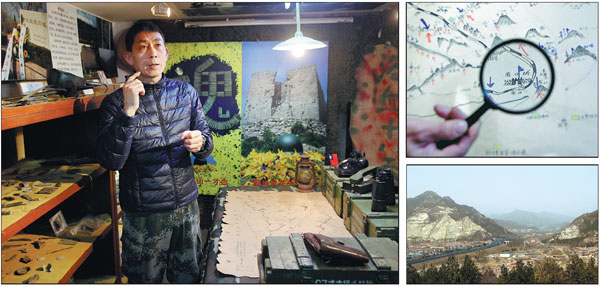
Left: Yang Guoqing, a mountaineering guide from Beijing, displays the exhibits in his small museum. Top right: Yang points out the location of Nankou on a map he drew himself. Bottom right: Yang discovered the site of the battle of Nankou while hiking and camping in the district a few kilometers north of Beijing. Photos by Zou Hong / China Daily |
Nearly 80 years ago, Chinese forces resisted the invading Japanese at a small hillside village just outside of Beijing. The soldiers' stories and the sacrifices they made have become an obsession for one resident of the capital, who is determined to keep their memory alive, as Zhao Xu reports.
On April 4, the day before the national Tomb Sweeping Festival, Yang Guoqing stowed two coffins in the trunk of his car and took a 20-minute drive to the hills near his home.
After walking uphill for two hours accompanied by about 40 people, Yang arrived at a piece of land less than 4 meters square.
"On one side was the Great Wall, while on the other was a steep slope leading to the base of the mountain," said the 52-year-old mountaineering guide, who lives in a northern suburb of Beijing.
"I had discovered two skeletons at that spot a few months earlier, so I took two small caskets along so I could bury the bones."
It was not the first time Yang had hauled coffins up the craggy incline, and he has conducted several memorial services for those who lost their lives in the rocky landscape almost 80 years ago.
In August 1937, fierce fighting broke out between 100,000 Chinese soldiers and the invading Japanese Imperial Army in the mountainous region on Beijing's doorstep. "Further north is the Inner Mongolia autonomous region. Historically, conquering armies from the north had to pass through this area before advancing farther south to the country's heartland. That's why the area is called Nankou, which means, 'Southern Mouth', " Yang said.
The situation faced by the Chinese army that fateful summer was one of the grimmest ever faced by a defending force. "The Japanese army had taken Beijing by the end of July (from the south), and now they were pouring in from the north. This meant that any army that sought to defend Nankou would have to fight on two fronts - the south and the north," he said.
"The Japanese army, with their armored fighting vehicles and bomber planes, predicted that Nankou would fall within three days of the attack, but the Chinese defended the village for 18 days, losing 10,000 men and killing about 3,000 of the enemy. After the battle, the Japanese collected the bodies of their dead and burned them, but this is the final resting place of the Chinese soldiers," he added.
Yang also took a trip to the mountains on a chilly, early spring day two weeks before the Tomb Sweeping Festival. The wind whistled through the skeletal branches of the trees where the buds had just begun to show, and the ancient horse trails used by traveling merchants were hidden under thorn bushes.
Except for the occasional tweet of a bird and the crackle of the dry leaves underfoot, everything was silent. That silence speaks evocatively to Zuo Bingde, an 88-year-old who has spent his whole life in Nankou. "I was just 10 when the fighting broke out. Every valley was filled with the deafening sound of gunfire. From our little house, I saw plumes of dark smoke rising up from the mountain ridges during the day, and the gleaming trajectories of the Japanese shells at night," he said.


Copyright 1995 - . All rights reserved. The content (including but not limited to text, photo, multimedia information, etc) published in this site belongs to China Daily Information Co (CDIC). Without written authorization from CDIC, such content shall not be republished or used in any form. Note: Browsers with 1024*768 or higher resolution are suggested for this site.
License for publishing multimedia online 0108263 Registration Number: 130349