|
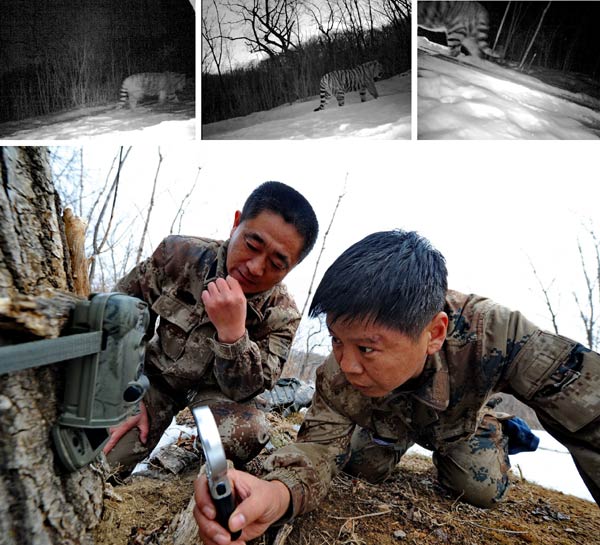
Rangers check wild tiger images captured on a hi-resolution camera at Hunchun Natural Reserve in Jilin province. [Photo/Xinhua] |
Making space
Despite the promising situation, conservationists say habitat fragmentation and an unbalanced food chain remain major challenges for tiger protection efforts.
Wu Jingcai, a researcher at the State Forestry Administration of China's Feline Research Center, said more woodland is being used for city construction and highway projects.
"We have called for wildlife habitats to be taken into consideration when making plans for infrastructure construction, so that we leave space for connecting habitats and corridors for animal activities," he said.
Chang at WWF China also expressed concern about the lack of funding from the central government to build nature reserves. "It's not easy to build a nature reserve on a local level, not to mention a national level," he said. "It needs large investment from the start and beyond."
Although the ban on commercial logging had removed another avenue for local authorities to make money, he predicted officials would be more proactive if the central government provided more funding and personnel.
"WWF China has made many plans with local governments, but all projects need funding, possibly tens of billions of yuan," Chang said. "If there were national tiger protection projects, just like for the giant panda, it could work. If not, the plans will just remain plans."
When it comes to prey for the tigers to hunt, he added that the problem is not density, but the type of animals roaming the forests.
Since 2010, the WWF has carried out an annual survey on ungulates - hoofed mammals - in Northeast China. Generally, it has found the numbers are growing.
Wang Fuyou, who helped set up Wangqing National Nature Reserve, said in 2011, when the reserve plan was mooted, the main issue was the lack of prey for big cats. "When we did the first survey, we felt like even 1,000 square kilometers area couldn't support one tiger," he said.
The situation today is better, with "definitely one roe deer within 1 sq km in some areas", according to Chang. The gap in density compared with Russia is narrowing, he insisted, but the problem is whether the density and balance can be sustained.
"For example, now we have many boar and roe deer but fewer spotted deer. This is not good for the tigers," Chang explained. "As they hunt, a tiger consumes energy. A spotted deer can support a tiger for seven days, but a roe can only support it for one or two days.
"In Russia, the prey structure is balanced. In China, the whole ecological system still needs time to recover."
Contact the writer at suzhou@chinadaily.com.cn


Copyright 1995 - . All rights reserved. The content (including but not limited to text, photo, multimedia information, etc) published in this site belongs to China Daily Information Co (CDIC). Without written authorization from CDIC, such content shall not be republished or used in any form. Note: Browsers with 1024*768 or higher resolution are suggested for this site.
License for publishing multimedia online 0108263 Registration Number: 130349