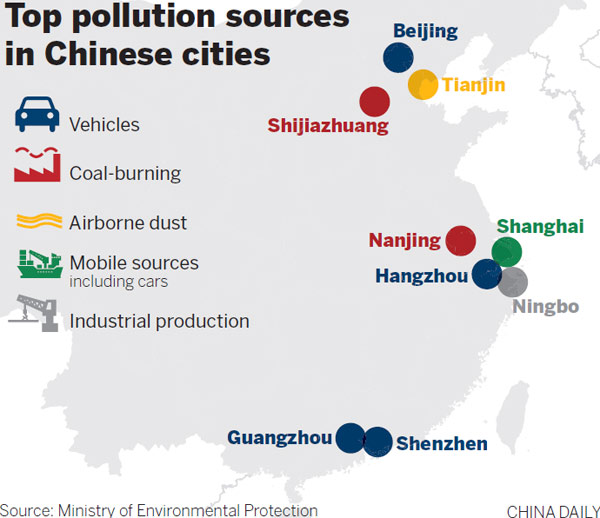
Vehicles, coal-burning, airborne dust and industrial production account for 85 to 90 percent of the major airborne pollution sources in most Chinese cities, new research shows.
Wu Xiaoqing, vice-minister of environmental protection, said at a conference in Wuxi, Jiangsu province, on Wednesday that scientists have analyzed sources of atmospheric particulates in nine cities, including Beijing, Tianjin and Shanghai.
Vehicles are the biggest polluters in Beijing, in Hangzhou, Zhejiang province, Guangzhou and Shenzhen in Guangdong province, while coal-burning emits most particulates in Shijia-zhuang, Hebei province, and Nanjing, Jiangsu province.
The major pollution source in Tianjin is airborne dust, while in Ningbo, Zhejiang province, it is industrial production. In Shanghai “mobile sources” are responsible for most of the pollution.
Finding the sources of atmospheric particulates requires analyzing those that are collected to trace emissions.
Chai Fahe, vice-president of the Chinese Research Academy of Environmental Sciences, said the investigation, led by the Ministry of Environmental Protection, began in 2013 and also involved the Chinese Academy of Sciences and the Chinese Academy of Engineering.
It aims to encourage local efforts to manage air pollution more efficiently.
“The results for Beijing, Tianjin and Shijiazhuang ... show that the three cities, although geographically close, have different types of pollution,” Chai said.
He said the result for Shanghai indicates its “uniqueness” in airborne pollution. The city’s thriving shipping industry, both domestically and internationally, means that its major polluter is “mobile sources” rather than simply vehicles, as in Beijing and Guangzhou.
The investigation has guided policymaking in some cities. For example, sources of atmospheric particulates in Beijing released in April last year showed that more than 30 percent of the local pollution came from vehicles. An updated emergency plan was announced on Monday.
If heavy smog persists for more than three days in Beijing, the capital will launch a top-level emergency plan to reduce pollutants, including limiting the use of private vehicles based on odd-and-even license plate numbers.
Chai said, “The next step is to work out apportioning sources of atmospheric particulates within larger regions. This could answer questions such as how pollutants flow and affect each other within regions such as the Beijing-Tianjin-Hebei cluster.”
Twenty-six more cities will disclose their sources of atmospheric particulates later this year. Wu said a detailed emissions inventory for the nine cities where pollution sources have already been apportioned will be released later.
Chai said the inventory will allow policymakers to locate sources of emissions accurately, adding that 12 cities started this work last month.


Copyright 1995 - . All rights reserved. The content (including but not limited to text, photo, multimedia information, etc) published in this site belongs to China Daily Information Co (CDIC). Without written authorization from CDIC, such content shall not be republished or used in any form. Note: Browsers with 1024*768 or higher resolution are suggested for this site.
License for publishing multimedia online 0108263 Registration Number: 130349