Population and innovation
Japan's economic stagnation that began in the 1990s is fundamentally caused by its aging population, and its rise after the 1960s and 1970s is a result of the baby boom after World War II and its efficient education system.
That the United States' population structure is more rational than that of Japan is an important reason why the US could maintain its innovation capacity after the 1990s while Japan's started declining.
China's census in 1964 showed young people under 15 years old accounted for more than 40 percent of its population. Yet, the proportion had fallen to 16.6 percent in 2010. By 2040, the median age of the US population will be about 40 years old, but China's will be about 50.
The UN predicts that the proportion of young people in China's total population will be even lower than that of Russia, only higher than the seriously aging Japan by 2030.
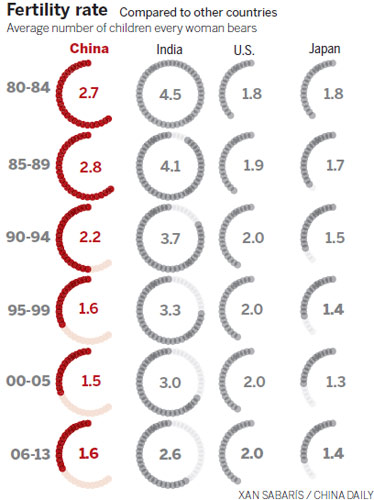
According to Yi Fuxian, a population policy researcher at the University of Wisconsin, if China cannot effectively stimulate young couples' willingness to have more children, India will overtake China in terms of population in 2040, when it will have 1.6 billion people, among whom 850 million will be of working age, compared with 690 million in China.
Worse, two-thirds of the young people in China, about 220 million now, are from the countryside, among whom more than 60 million are children living with their grandparents in villages left behind while their parents work in cities, and more than 30 million are migrant children living an unstable life with their migrant worker parents.
China's input in education approached 4 percent of GDP, an international benchmark, in 2012. But the excessive concentration of quality education resources in several big cities means many rural young people cannot enjoy proper education.
The government urgently needs to provide better healthcare, education, pensions, and employment opportunities, so as to minimize the former rigid family planning policy's negative influence on the national economy.
How to maintain a dynamic financial balance between caring for the elderly, and cultivating the youth, and between now and the future will be difficult tests for Chinese decision-makers.
But as Cai Fang, an economist at the Chinese Academy of Social Sciences in Beijing, said, if the government can accomplish the missions, the country's population dividends and comparative advantages in contrast with the other emerging economies will last to 2020.


Copyright 1995 - . All rights reserved. The content (including but not limited to text, photo, multimedia information, etc) published in this site belongs to China Daily Information Co (CDIC). Without written authorization from CDIC, such content shall not be republished or used in any form. Note: Browsers with 1024*768 or higher resolution are suggested for this site.
License for publishing multimedia online 0108263 Registration Number: 130349