BEIJING - Air pollution reached "dangerous levels" in 106 Chinese cities at the height of the celebrations welcoming the Lunar New Year due to use of firecrackers and fireworks, a Xinhua tally has found.
 |
|
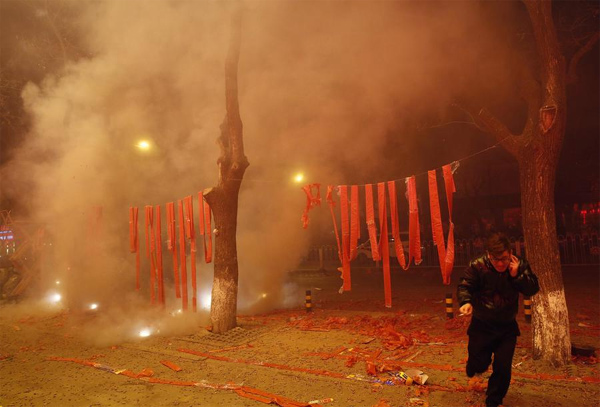
A man runs after lighting firecrackers to celebrate the start of the Chinese New Year in Beijing early February 19, 2015. [Photo/Agencies] |
Between 8 pm on Wednesday and 10 am on Thursday, the Air quality index (AQI) surpassed 300 in 106 cities. Based on China's standard, an AQI between 201 and 300 is considered "heavy pollution", and an AQI of over 300 is defined as "serious".
The China National Environmental Monitoring Center (CNEMC) put the number of air-polluted cities at 201 from Wednesday night to the daytime of Thursday. More than 40 of them saw "serious pollution."
Beijing had a superb day on Wednesday in the daytime as the AQI was below 50. While the fireworks celebrations in the night ruined it.
"I just showed off the 'blue sky' on my social network in the morning but the smog came back in the night," lamented a Beijing resident surnamed Chen.
The municipal environment bureau said pollutants rapidly increased from 8 pm on New Year's eve sufficiently to cause "heavy pollution" at midnight.
The peak readings of PM 2.5, the airborne particles smaller than 2.5 microns in diameter that causes smog, reached 410 mg per cubic meter between midnight to 1 am on Thursday, up 12 percent year on year, according to the Beijing Municipal Environmental Monitoring Center.
Skies in the neighboring Tianjin Municipality and Hebei Province were also polluted due to fireworks. The PM 2.5 level did not drop from its peak until 3 a.m. Thursday, according to the CNEMC.
Cities in the northeast as well those in Sichuan and Gansu provinces also suffered heavy air pollution, CNEMC's statistics showed.
A single firecracker would cause heavy pollution within an area of 10 cubic meters, according to the experiment by Shangguan Wenfeng, a professor with the Center for Combustion and Environmental Technology with the Shanghai Jiao Tong University.
Setting off fireworks during the Lunar New Year is an age-old tradition in China, with ancient superstitions believing the light and sound would scare away evil spirits. In more recent years, they're used to bring a festive atmosphere during the country's most important holiday.
However, fireworks have been increasingly blamed for contributing to the country's smog problem, pushing local governments to implement measures forbidding or limiting firework displays.
Firecracker orders at Beijing retailers are down 20 percent this year as authorities have slashed the number of permitted sales days and reduced retail spots amid pollution concerns.
Firecrackers are officially available at temporary retail spots across Beijing ahead of the Lunar New Year. Beijing authorities have cut the number of days when firecrackers may be sold from 20 to 11.
But it is a different scenario in the countryside, where there is no restrictions on firecrackers.
The consumption of fireworks in the countryside is on the rise in recent years, said Li Shuai, a staff with the Anhui Provincial Fireworks and Firecrackers Association.
In Qianshan County alone, the sales revenue is more than 50 million yuan (8.16 million US dollars) per year, said Li.
"The living standard in rural areas is increasing and setting off firecrackers has become a way of blessing and entertainment for rural residents," he said.
Migrant workers who come back home always set off a large number of firecrackers during the New Year to show off how much they have earned in the cities, said Wei Bin, a cultural official in Rongshui Miao Autonomous County in south China's Guangxi Zhuang Autonomous Region.
"Because of the restrictions in the cities, some urban residents choose to indulge themselves in the fireworks show in the countryside," said Shi Ke, who is in charge of a fireworks company in Guangxi.
Setting off firecrackers definitely will cause short-term air pollution but it is not fair to blame the cause of smog solely to firecrackers, said Pan Gongpei, a professor with Nanjing University of Science and Technology.
When expecting the government to do more to curb pollution, the public should also try to change their mindset and way of living by setting off less firecrackers or abandoning the habit to contribute to more "blue skies," said Pan.


Copyright 1995 - . All rights reserved. The content (including but not limited to text, photo, multimedia information, etc) published in this site belongs to China Daily Information Co (CDIC). Without written authorization from CDIC, such content shall not be republished or used in any form. Note: Browsers with 1024*768 or higher resolution are suggested for this site.
License for publishing multimedia online 0108263 Registration Number: 130349