 |
|
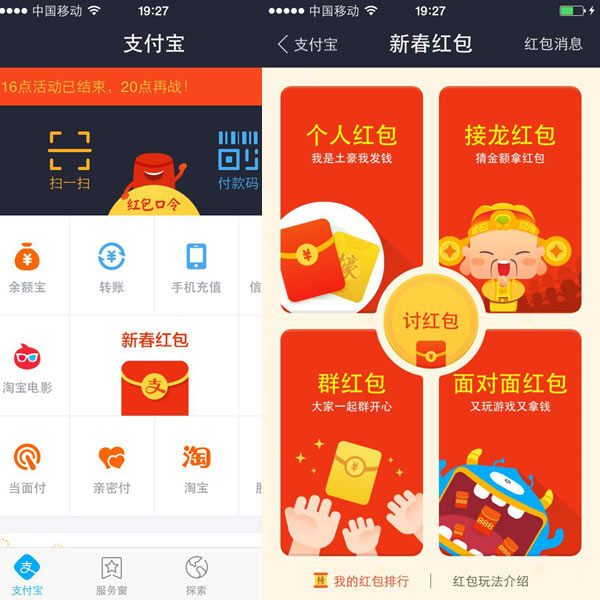
Screenshots show the app of Alipay Wallet, the mobile payment application backed by Alibaba Group Holding Ltd. [Photo/chinadaily.com.cn] |
BEIJING - Ten days before China's Lunar New Year, Luo Cheng, a copywriter in a company in southwest China's Chongqing Municipality, began to prepare for her home return. Unlike previous years, she had no New Year goods to carry back.
"I bought clothes for my parents, and toys, books and candies for my nephews on the Internet. They've already received the presents at home," she says. Her nephews are very happy with their gifts, which are better than items sold locally.
The traditions of Spring Festival are changing as China modernizes and urbanizes. The spread of the Internet is changing the way people mark the ancient festival.
In south China's Guangdong Province and other Cantonese-speaking regions, people usually buy mini orange trees to welcome the Lunar New Year, as the Cantonese word for "orange" sounds similar to the word for "auspicious". An old saying goes: "The New Year is incomplete without a visit to the flower market."
However, since 2011, mini orange trees have been sold online at lower prices and delivered direct to the buyer's home. Such convenience is welcomed by younger generations, who don't want to spend time choosing a tree and carrying it all the way home.
The flower markets are suffering. In this year's tenders for flower market stands in Guangzhou's Tianhe District, the best position was won by a vendor of beef meatballs. A critic in a local newspaper described it as "bizarre", saying, "Like it or not, traditions are being unavoidably changed by the Internet."
Elsewhere, e-commerce is enhancing traditions. In east China's Nanjing, home to the popular lantern shows at Qinhuai Denghui (Qinhuai River carnival) during the Spring Festival, online lantern shops are booming.
"Many buyers like traditional lanterns - they can bring a family good luck," says a craftsman who sells lanterns on Taobao, China's biggest e-commerce website.
Taobao and other shopping websites even sell the main event - the New Year's Eve dinner, when the whole family gather to celebrate the coming of spring.
On Taobao alone, more than 4,600 pre-cooked dinner products are available, with prices ranging from 88 yuan (about $14) to 2,888 yuan. The most popular, a ten-dish package, sold 1,600 meals for 268 yuan each in one month.
"The dishes are delivered on time, are easy to prepare and taste good. It saves me having to cook when the restaurants are booked out," one comment said.
However, some customers miss the atmosphere of families preparing the food together. "It is not about food; it's about the feeling," another comment said.
Meanwhile, younger generations are using smartphones and mobile Internet to continue traditions such as bainian (send New Year greetings to friends), and yasuiqian (giving money to children for good fortune).
Wang Yao, a postgraduate student at Tsinghua University, uses Alipay, the payment system run by China's Internet giant Alibaba, to give yasuiqian to his younger relatives. "They are far away and difficult to visit, so online payment helps," he says.
Wechat, the multi-million-user mobile messaging software developed by Tencent, will be the busiest smartphone application during the Spring Festival, distributing billions of bainian messages and virtual hongbao (red envelopes containing a cash gift).
Hongbao are one of hottest sub-applications of Wechat. A user can give a group of friends a certain mount of money through the Wechat payment system, and they can claim random amounts, like a lucky dip.
"It's really fun, and I can spend 1,000 yuan to make all my friends happy," says Wang Yao. "It's hard to imagine giving honhungbao like this in real life."
Alipay and Wechat also have offered their users hongbao -- 600 million yuan and 3.6 billion yuan respectively in cash and online shop coupons. Other Internet players have followed, but critics complain this is commercializing the festival.
Even firecrackers have gone virtual. This Spring Festival tradition is banned in 138 cities and strictly limited in another 536 cities due to the smog it creates. But for those who really miss it, the flashing lights and bangs are available on the Internet.
Nanjing woman Sun Jing, 30, buys many New Year goods online: "But I still miss the old times when I opened my father's trunk to find candies and new dresses he brought from far away for me. That's something you can't get online."


Copyright 1995 - . All rights reserved. The content (including but not limited to text, photo, multimedia information, etc) published in this site belongs to China Daily Information Co (CDIC). Without written authorization from CDIC, such content shall not be republished or used in any form. Note: Browsers with 1024*768 or higher resolution are suggested for this site.
License for publishing multimedia online 0108263 Registration Number: 130349