|
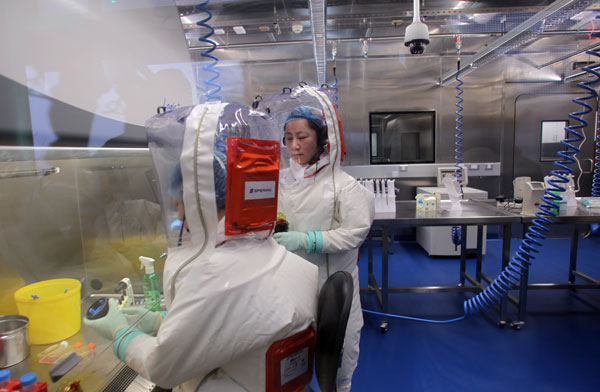
Scientists wearing protective clothing work in the experiment zone at China's first P4 laboratory in Wuhan, Hubei province, on Saturday. Anyone entering the facility has to have undertaken rigorous training to ensure safety and security. Zou Hong / China Daily |
Researchers to study Ebola and other threats at center with top biosafety rating
It kills. It can affect humans and animals. It is incredibly small and can be seen only with extremely strong microscopes. It is a virus.
Experts say the only way to fight such invisible threats is to understand them better, and that is why the country has built its first biosafety level-4, or P4, laboratory.
The facility at Wuhan, the capital of Hubei province, was inaugurated on Saturday.
The BSL-4 designation applies to laboratories that take the highest level of biosafety precautions to enable researchers to work with the most dangerous viruses, such as Marburg, Variola and, of course, Ebola.
The latest figures show that, as of Sunday, 22,495 people have been infected and 8,981 have died in the current Ebola outbreak in West Africa.
"Only with such high standards of protection can we carry out experiments with live fatal viruses, instead of gene or protein fragments of them," said Yuan Zhiming, director of the Wuhan lab.
"Globalization and lifestyle changes pose serious challenges to public health by creating and spreading emerging infectious diseases. Building high-protection-level laboratories is an effective way to help control diseases."
Asia's first P4 lab
Previous media reports said there are 59 P4 laboratories worldwide, though many are not operational.
Yuan estimates there are more than 20 P4 laboratories in service worldwide in countries such as the United States, Britain, Germany, France, Canada, Australia and Switzerland.
However, the existence of some of them has not been officially confirmed by the governments concerned.
"When China's P4 laboratory is formally put into service, it will be the first operating P4 laboratory in Asia, and will definitely contribute to the prevention and control of infectious diseases," Yuan said.
The laboratory will be run on a trial basis for up to 18 months, and will then go into full service provided it receives approval from the central government.
Scientists from home and abroad will be able to use the centers's three cellular level laboratories, two animal laboratories, anatomy room and virus storage room.
Chen Xinwen, director of the Wuhan Institute of Virology, said, "A P4 laboratory is different from other large-scale science facilities, as anyone who enters has to have completed security training."
The institute is the laboratory's parent body and took part in its design and construction with the help of the Jean Merieux Laboratory, a P4 facility in Lyon, France.
At present, only six Chinese scientists have been trained to work in P4 facilities. The scientists from Wuhan traveled to Lyon to learn the necessary security procedures.
"Now we have sent a second group of people for training, including some key employees like maintenance personnel," Chen said.
Hu Zhihong, a leading virologist, is one of the six scientists trained in the first group.
"The unique thing about a P4 laboratory is the high level of security," she said.


Copyright 1995 - . All rights reserved. The content (including but not limited to text, photo, multimedia information, etc) published in this site belongs to China Daily Information Co (CDIC). Without written authorization from CDIC, such content shall not be republished or used in any form. Note: Browsers with 1024*768 or higher resolution are suggested for this site.
License for publishing multimedia online 0108263 Registration Number: 130349