 |
|
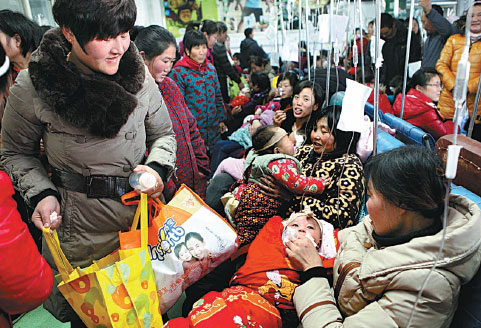
Parents take their children to be fed by drips in a crowded room in a public hospital in Ganyu county, Jiangsu province. Many are now opting for private care for their families. Si Wei / for China Daily |
Loosening ties
"We are considering further loosening the ties between hospitals and doctors, so they can practice in different medical institutions freely," she said
Yu Ying, who set up a private clinic last year, said the changes have definitely made it easier for doctors to practice at different institutions. "Many doctors I knew before called me to apply for part-time work at my clinic," said Yu, who worked as emergency room doctor at Peking Union Medical College Hospital for several years. "But a few years ago many doctors had to do this secretly."
For Zhu Gang, working two days a week at Beijing United Family Hospital not only provides extra income, but, more important, also offers good opportunities to research and practice in a different environment, and that could be useful in his future research and work.
"The hospital's management system and diagnosis ideology are very different from those in public hospitals. I'm glad to have the opportunity to learn about international standards of care, which I wouldn't have learned if I'd stayed in a public hospital," he said.
Besides practitioners such as Zhu, who seek part-time work in private institutions to broaden their professional horizons, other doctors have turned away from public hospitals in the hope of better fulfilling their dream of being a doctor.
Jin Limin, who worked at the Capital Institute of Pediatrics Children's Hospital for nine years, joined Beijing United Family Hospital in 2013 because she wanted to be "a doctor in the truest sense".
She said: "A large part of my work was unrelated to treating patients, and I had to take many other things into account, such as the circulation of hospital beds, and the amount of time I should spend on each patient under the pressure of the evaluation system. I hope to find a place where all I need to consider is how to better serve my patients."
The excessive workload was also a reason for her move into private care, she added.
Yu Ying has set up a clinic in partnership with the AmCare Group of the United States. The greatest incentive for starting her own business was to establish a model of service that accorded with her concept of "happiness and respect", she said.
Excessive workload
After working as an emergency doctor for 12 years, Yu found her "doctor dream" was far from the reality. "I felt miserable back then, and my patients were also unhappy," she recalled.
Like many of her colleagues at Peking Union Medical College Hospital, Yu's workload was heavy because of the large numbers of patients, some of whom had traveled as far as 1,600 kilometers to be treated.
In addition, she also had to handle a number of extra duties, such as appeasing angry relatives of patients who had to wait for treatment in the emergency surgical rooms, which were almost always full.
"After working for more than a decade in the emergency department I found I had to deal with all sorts of disputes between patients and doctors and nurses," Yu said. "I felt I would be no different from a community mediator if I stayed."
The official policies encouraging the development of private healthcare prompted Yu to start her own business. In June she started to apply for a license for the clinic, which is scheduled to open in February, after Chinese New Year. "It wasn't as difficult as I'd expected," she said. "I didn't go through too much bureaucracy. I think Beijing has done this much better than many other cities."
In recent years, the central government has issued a number of measures aimed at supporting the development of a private medical sector, such as facilitating the talent flow from public to private hospitals, and encouraging foreign investment in the private sector.
By the end of the first three quarters of 2014, there were 11,963 private hospitals in the country, an increase of 11 percent from the same period the previous year, reducing the gap with public hospitals, according to the National Health and Family Planning Commission.
Wang Hong, chairwoman of the private Beijing Huilan Hospital, said the government needs to provide a wider range of measures to regulate investment in the sector and ensure its healthy development.
"Many investors don't have the right concept. They just want quick profits," she said. "But in the health sector, that's simply not the case."
That may be true for some new arrivals, but for Yu, the move into the private sector is about professionalism, not profits: "I want to provide an environment where the doctors are happy treating the patients, and the patients are happy to consult the doctors. But in many public hospitals that's hard to achieve."
Contact the writer at wangxiaodong@chinadaily.com.cn


Copyright 1995 - . All rights reserved. The content (including but not limited to text, photo, multimedia information, etc) published in this site belongs to China Daily Information Co (CDIC). Without written authorization from CDIC, such content shall not be republished or used in any form. Note: Browsers with 1024*768 or higher resolution are suggested for this site.
License for publishing multimedia online 0108263 Registration Number: 130349